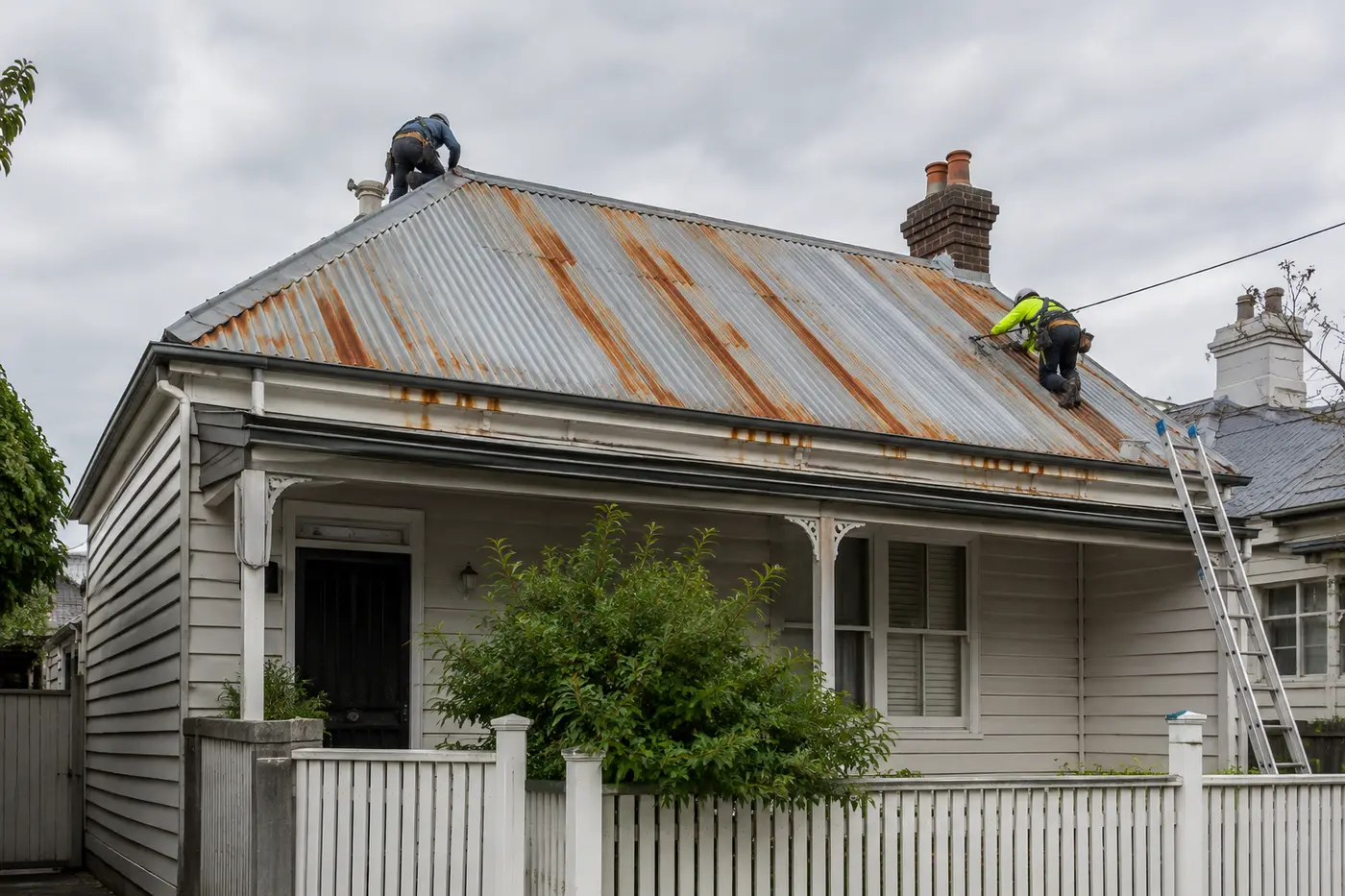
It usually starts in the gutter. You scoop out the leaves and find flakes of orange metal mixed through them, or you notice brown streaks running down the sheets towards the eaves that weren't there a few summers ago. If you've got a rusty tin roof on an older house in Melbourne's north, the question on your mind is a simple one: can this be saved, or am I up for a new roof?
Most of the time the answer comes down to one thing. Is the rust sitting on the surface, or has it eaten through the steel? Here's how we tell the difference, what each outcome means for you, and why you shouldn't climb up there to check for yourself.
Most "tin" roofs are really zinc-coated steel
Nobody has roofed a house in actual tin for a very long time. What people call a tin roof is almost always corrugated steel with a thin protective metal coating. On older homes that coating is zinc, which is where the name galvanised iron comes from. On later roofs it's usually Zincalume, a blend of aluminium and zinc.
The coating is the whole story. Zinc protects the steel by slowly wearing away in its place, so while there's coating left, the steel underneath stays sound. Once it wears thin in a spot, the bare steel starts to rust. And rust moves a lot faster than the coating ever wore.
Across the north we mostly see these roofs in two places. One is the 1970s and 80s corrugated iron and older Zincalume around Reservoir, Coburg and the inner north. The other is period weatherboards and terraces in suburbs like Brunswick and Northcote, where corrugated iron was a common roof from the start.
Rust starts in the same few places every time
Rust on an old tin roof is rarely spread evenly. It begins wherever water sits longest or the coating has been broken:
- Sheet laps, where one sheet overlaps the next and moisture gets drawn into the gap
- Nail and screw holes, especially on older roofs fixed with lead-head nails that have lifted as the timber moved
- The bottom ends of the sheets at the gutter line, which carry the most water
- Anywhere leaves pile up, which under the big street trees of the inner north can be a fair chunk of the roof
- Below copper or lead, because runoff from an old copper pipe or lead flashing speeds up corrosion on zinc-coated steel
That pattern is worth knowing. A roof with rust only at the laps and fixings is often in better shape than it looks from the street, because the open middle of each sheet still has its coating.
Surface rust and rust-through are two different jobs
Surface rust is the orange or brown discolouration on top of the sheet. The steel underneath is still whole. It looks bad and it will get worse if it's ignored, but it can be treated.
Rust-through (roofers also call it perforation) is when the steel has rusted all the way through, leaving pinholes or ragged gaps. No coating will hold there, because there's nothing solid left to coat.
You can get a fair idea without going near the roof. On a sunny day, go into the roof space with a torch, switch it off once you're in, and let your eyes adjust. Pinpricks of daylight through the sheets mean the steel has perforated in those spots. Stay on the ceiling joists and never step between them. Rust-coloured stains on the ceiling, insulation or timbers point the same way, and rust flakes in the gutters tell you the coating has been gone for a while.
What you can't judge from inside is how far the damage spreads around those holes, or whether the battens (the timber strips the sheets are fixed to) have gone soft where water has been getting in. That needs someone on the roof.
A sound tin roof can be restored, and it's worth doing
If most of the steel is still solid, restoration is usually the better value. On a rusty tin roof the work goes roughly like this. Surface rust is removed mechanically, then treated with a rust converter so what's left can't keep spreading. Any sheets that have rusted right through are replaced. Lifted nails and tired screws are swapped for new fixings. Then the whole surface is primed with a metal primer and finished in a professional-grade elastomeric coating, in the colour you pick.
Often, a full restoration like that extends the life of a sound roof by 10 to 15 years at a fraction of replacement cost. It's work we do regularly on older corrugated iron and Zincalume roofs across the north, and our restorations carry a 10-year written guarantee on workmanship and materials (conditions apply).
Gillian Hibbert, who had a metal roof restored with us, wrote: "We recently had Ian restore and paint our metal roof and gutters. He did an amazing job. Nothing was too much trouble."
Some roofs are past saving, and we'll tell you
Painting over a roof that has given out only hides the problem for a while. The signs are rust-through scattered across many sheets rather than a few, steel that crumbles or flakes away in layers, and battens underneath that have gone soft from years of water getting in. If a handful of sheets are gone, replacing those and restoring the rest still makes good sense. If most of them are gone, you'd be paying to coat steel with nothing left to give.
A new roof does fix a couple of things old tin roofs are known for. Older corrugated iron with no sarking (a protective layer laid under the sheets) or insulation can be loud in heavy rain, and a replacement is the chance to put that in. If yours is a newer Colorbond roof rather than old galvanised iron, the warning signs are a little different, and we cover them in our guide to how long a Colorbond roof lasts.
Period homes have one extra step
Parts of Brunswick and Northcote sit under heritage overlays, and on those homes there may be limits on changing the roof material or colour. Swapping old corrugated iron for something different isn't always your call alone. Restoring the existing iron in a fitting colour is usually the simpler path, but we still check what applies to your address before any work starts. Our heritage and period roof work is set up for exactly these houses.
Please don't walk on a rusty roof to check it
We mean this one. Old corrugated iron that looks fine from below can be thin enough at the laps and fixings to give way under a person's weight, and rust makes the surface slippery and the edges sharp. A fall from even a single-storey roof can cause serious injury. Look from the ground, look from the roof space, and leave the walking to someone with the right safety gear.
Found rust in the gutters or daylight through the sheets? The next step is a proper look. We inspect metal roofs across Melbourne's north for free, tell you plainly whether yours can be restored or needs new sheets, and put it all in a written quote. Read more about restoring and replacing metal roofs, or call us on (03) 9498 1000.