
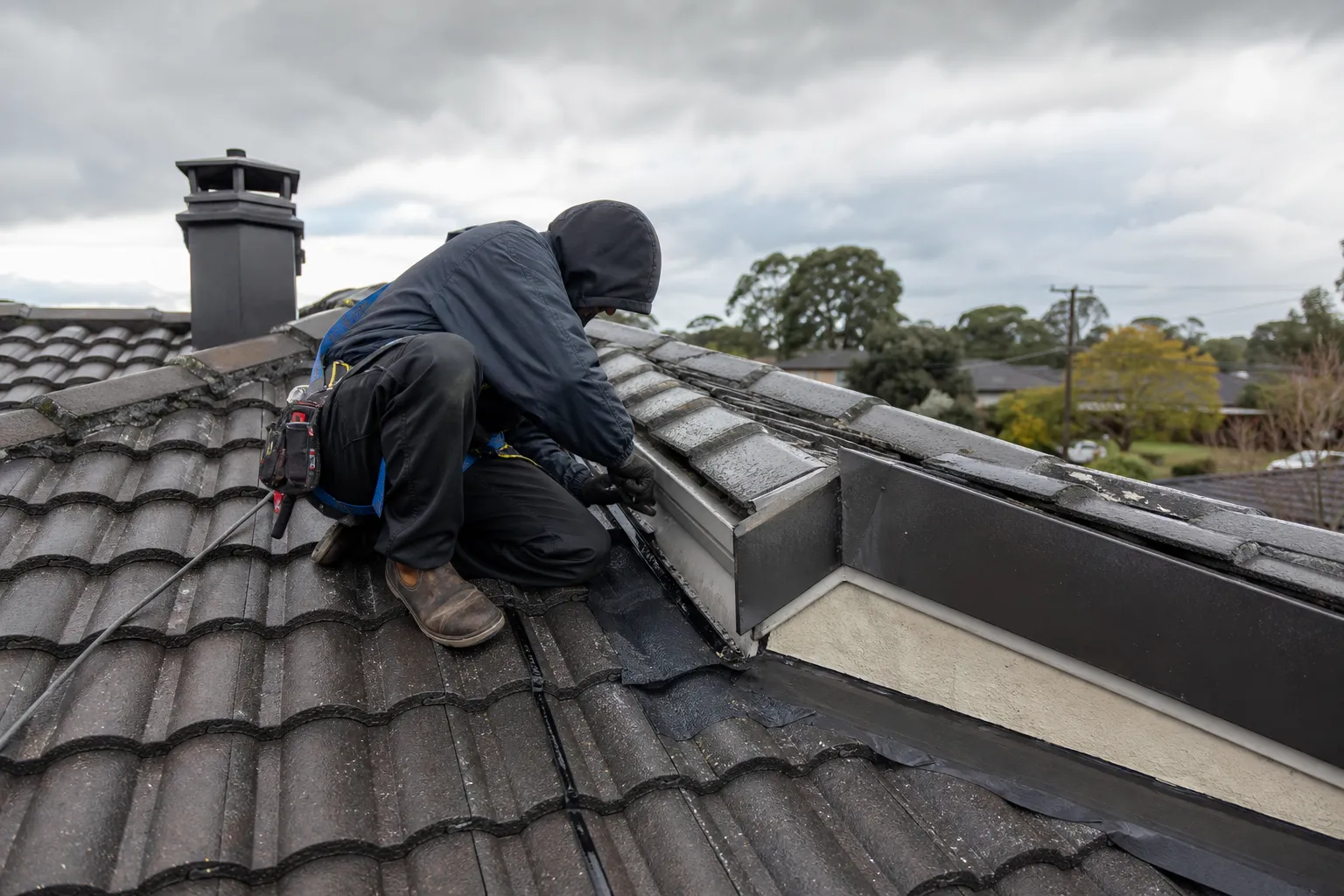
Winter is when the northern suburbs' roofs get their hardest test of the year. From June through August, cold, wet weather drives rain under loosened ridge caps, backs it up in clogged valleys, and finds every tired joint on the 80-to-100-year-old terracotta and concrete tile roofs that fill Preston, Reservoir, Coburg, Thomastown and Epping. If a brown ring has appeared on your ceiling after a heavy night of rain, you're not alone. Most winter leaks are traceable and fixable once you know how water behaves up there.
This guide walks through how to find the source, the condensation problem that gets misdiagnosed as a leak every winter, and how to tell when a patch repair genuinely solves the problem versus when a full roof restoration is the more honest (and cheaper in the long run) answer.
Is it actually a leak, or is it condensation?
Before you chase a leak, rule out the thing that imitates one. In cold Melbourne winters, warm moist air from inside the home (showers, cooking, unflued heating, drying clothes) rises into the roof space and meets the cold underside of the tiles or sarking. It condenses there, drips back down, and stains a ceiling in a way that looks exactly like a leak.
The tells differ, though. Condensation damp appears in still, cold weather (not only during rain), shows up over bathrooms, kitchens and laundries, spreads evenly rather than at one point, and brings a musty smell or mould on the underside of the roof. A poorly ventilated roof space with blocked or absent eave vents makes it worse. It's a real problem worth fixing, but sealing tiles or repointing ridges won't touch it, so diagnosing it first saves you paying for the wrong repair.
How to trace a leak back to its source
The single most important thing to understand is that water rarely enters directly above where it drips. It gets in at a high point, runs along the underside of a tile, down a rafter or across the sarking, and only falls once it reaches a batten, a nail, or a low spot, often a metre or more from the actual entry point. That's why the wet patch on your ceiling is a starting clue, not the answer.
From the ground and from inside, here's what genuinely helps narrow it down:
- Note when it leaks. Only in driving rain from one direction points to wind-driven entry under caps or flashing. Every time it rains hard suggests a valley or a cracked tile. In heavy rain only (never light) often means overflowing gutters or valleys, not a hole.
- Look in the roof space with a torch during or just after rain, from the safety of the manhole or a fixed platform, never by climbing about. A wet trail on the timber or sarking leads uphill toward the entry point.
- Map it to what's above. Is the stain under a valley, near the chimney, below a skylight, or along a wall junction? Those junctions are where most roofs fail.
What you should not do is climb up to look. Wet, aged tiles offer no grip and crack underfoot. Tracing from inside and below is useful and safe; confirming and fixing it is a job for someone with roof anchors and the right footing (more on that below).
Where northern-suburbs roofs actually leak
On the older tile roofs common across the north, the same handful of failure points come up again and again:
Valleys
The metal channels where two roof planes meet carry huge volumes of water in a downpour. Old galvanised valleys rust through, and leaf litter from the north's mature street trees dams them so water backs up under the tiles, one of the most common winter leaks we trace, and core roof plumbing work.
Ridge and hip pointing
When the mortar bedding and pointing along the ridge lines frets and cracks (near universal on Preston and Coburg bungalows), caps loosen and wind-driven rain drives straight underneath. This is the classic "leaks only in a southerly" pattern.
Flashings and junctions
Where the roof meets a chimney, wall, skylight or vent pipe, the flashing seals the join. Old, lifted or poorly sealed flashing is a prime entry point, often the source of intermittent leaks that seem to have no cause.
Cracked, slipped or porous tiles
A single cracked tile, one slipped out of line, or porous tiles that soak up water rather than shedding it will all let water through in sustained rain.
Gutters and downpipes
Overflowing, sagging or blocked gutters push water back up under the eaves. If your "leak" only shows in the heaviest rain near an external wall, clear gutters and downpipes are often the real fix.
Patch repair or full restoration?
This is the question worth getting right, because the answer decides whether you spend hundreds or thousands.
A patch repair is the right call when the roof is fundamentally sound and the leak is isolated. Replacing a few cracked tiles, resealing one flashing, repointing a section of ridge, or renewing a rusted valley are all targeted repairs that genuinely stop the water. If the rest of the roof has life left, patching is sensible and exactly what you should do.
Restoration becomes the smarter money when the leak is a symptom, not the disease. The pattern to watch for: you fix one leak and another appears a month later; the ridge pointing is fretting along the whole roof, not one spot; multiple tiles are cracked or porous across several areas; valleys and flashings are all rusting on the same timeline because they're all the same age. At that point you're paying for repeat call-outs to chase a roof that's failing everywhere at once. A restoration (replacing broken tiles, re-bedding and repointing every ridge and hip, renewing valleys, cleaning off the moss holding moisture, and recoating the surface) resets the whole roof and is far better value than a dozen patches. Not sure which side of the line your roof sits on? An honest roof inspection with photos will tell you plainly.
Why waiting until spring costs more
It's tempting to slide a bucket under the drip and wait for dry weather. But a small winter leak doesn't pause. Every week of Melbourne rain drives more water into the timbers, insulation and plaster. Saturated insulation stops working and needs replacing, wet framing invites rot and mould, and a ceiling merely stained in June can sag by September. A modest repair becomes a structural and plaster job. Acting while the leak is small is almost always the cheapest fix.
A clear safety boundary
Please don't inspect or patch a roof yourself in winter. Wet, mossy, ageing tiles offer no grip, terracotta breaks underfoot, and a fall from roof height is life-changing. Tracing the likely source from inside your ceiling space and from the ground is genuinely helpful and completely safe. Leave the on-roof confirmation and repair to a professional with proper anchors and equipment.
Frequently asked questions
Why does my roof leak sometimes and not others?
Intermittent leaks almost always come down to direction and volume. Wind-driven rain from one quarter gets under loose ridge caps or lifted flashing that stay dry in gentle rain, while blocked valleys and gutters only overflow in the heaviest downpours. The inconsistency is a clue to where the water is getting in, not a sign there's nothing wrong.
Can you have a roof leak and not know it?
Yes, and it's common. Water can track along timbers and soak into insulation for months before it ever marks a ceiling, quietly feeding rot and mould in the roof space. A musty smell, unexplained damp, or higher-than-usual heating bills can all be early signs worth a look.
How do professionals find the exact source?
By working from the inside out: tracing wet trails in the roof space uphill, checking the known failure points above the stain, and, where needed, controlled water testing, wetting sections in sequence while watching inside for the drip. It beats guessing.
Seeing a stain spread after this winter's rain? We trace and fix roof leaks across Melbourne's northern suburbs, including Preston, Reservoir, Coburg, Thomastown and Epping. Get in touch for an honest assessment and a free quote before a small leak becomes a big one.