
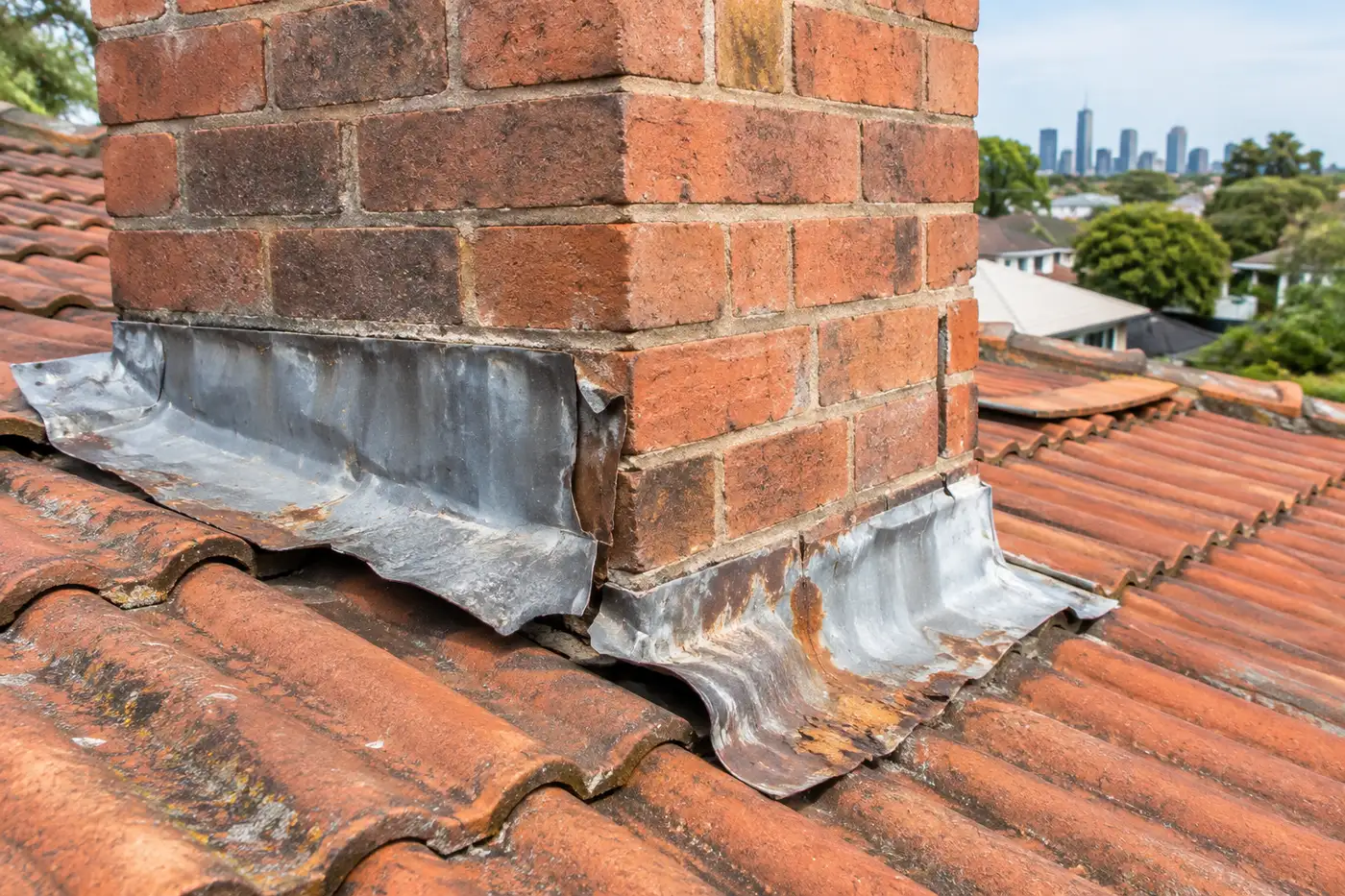
Most flashing problems start with a stain. A brown ring on the ceiling near the chimney, a damp patch above a window, a bit of paint bubbling in the hallway after a night of driving rain. The tiles look perfectly fine from the footpath, so people assume the roof itself is fine. It usually is. The leak is almost always coming from the flashing, and roof flashing repair is one of the most common jobs we get called out for across Melbourne's northern suburbs.
Here is the part that surprises people. The main field of tiles or sheets on your roof rarely leaks. It is built to shed water and it does that job for decades. Water gets in at the joins, and flashing is what seals those joins.
What flashing is, and why it goes first
Flashing is the metal that bridges the gaps where your roof meets something else. Where it butts up against a chimney, runs alongside a parapet wall, wraps around a skylight, or folds into a valley between two roof pitches. Older homes around Preston and Coburg often still have lead flashing dressed in by hand. Newer estates out in Craigieburn and Mill Park tend to have Colorbond or galvanised flashing cut to size.
It fails before the rest of the roof for a simple reason. Flashing takes the worst of everything. It sits at the exact points where water is funnelled and concentrated, it expands and contracts more than the roof around it, and on older jobs it is often held with mortar or sealant that has a much shorter life than the metal itself. When that mortar cracks or the sealant perishes, the metal lifts a fraction and water tracks straight underneath.
The spots where flashing lets go
When we go up to chase a leak, these are the places we look first, roughly in order of how often they are the culprit:
- Chimneys. Very common on the period homes through Brunswick and Northcote. The mortar fillet cracks, or the old lead has torn where it steps down the brickwork.
- Valleys. The metal channel where two roof slopes meet. It carries a huge volume of water, and once it rusts through or the tiles beside it slip, it leaks badly and fast.
- Skylights. The flashing kit around a skylight is a frequent offender, especially if the unit is more than fifteen years old.
- Wall and parapet junctions. Anywhere a roof runs into a rendered or brick wall, common on extensions and townhouses.
- Metal roof penetrations. On Colorbond roofs it is often the flashing around vents, aerials or where a newer section was tied into an older one.
How to tell the flashing is the problem
You do not need to get on the roof to make a fair guess. A ceiling stain that sits close to a chimney breast, a wall, or a skylight points at flashing rather than a cracked tile out in the open. Leaks that only show up in heavy, wind-driven rain and then dry out are another strong sign, because that is exactly when water gets pushed up and under lifted metal.
From ground level with a pair of binoculars you can sometimes spot the giveaways yourself: rust streaks running down from a valley, mortar crumbling out of a chimney join, or a section of flashing that has visibly lifted or curled at the edge. If you have had recent storm work in the street, check after the next big blow, because wind events across the northern plains lift flashing more often than they crack tiles.
The honest answer, though, is that leaks travel. Water can enter at the flashing and appear in the ceiling two metres away. That is why a proper look on the roof beats guessing, and it is a big part of what a winter leak in a northern-suburbs home usually turns out to be once someone actually gets up there.
Repair or replace: what we usually do
Not every bit of tired flashing needs ripping out. If the metal is sound and it is the mortar or sealant that has failed, we can often re-dress and re-seal the existing flashing and get many more years out of it. Where the metal has rusted through, torn, or been butchered by a previous patch job, replacement is the sensible call. Lead and modern Colorbond flashings both have their place, and the right choice depends on the roof and, on heritage-overlay streets, on what the look demands.
What we try to avoid is the endless silicone smear. A tube of sealant over a failing valley buys you a wet winter or two and then you are back where you started, usually with more damage underneath. Flashing is roof plumbing, and it is worth having it done as roof plumbing. Our flashing and valley repair work covers the joints where old roofs actually leak, done to last rather than to get you off the phone.
What the job involves on the day
A straightforward flashing repair is often a same-visit job. We lift or set aside the tiles beside the affected area, remove the failed mortar or old metal, fit and dress the new flashing, then re-bed and point it in so it sheds water the way it should. Valleys take longer because the tiles down both sides usually have to come off and go back. Chimney work can involve a fresh mortar fillet as well as new stepped flashing.
If the leak has been going a while, we will also check what is underneath. Wet timber, sagging plaster and stained sarking do not fix themselves once the flashing is sorted, so it is better to know the full picture early. One customer, Mark Johnston, put it well after we finished his place: "true professionals, transformed the whole look of the house, very thorough and have an eye for detail." That eye for detail matters most on the small stuff like flashing, where a five-minute shortcut becomes next year's leak.
What drives the cost
There is no single price for flashing repair, and anyone quoting one over the phone without seeing the roof is guessing. What moves the number is real: how much flashing is failing, whether it can be resealed or has to be replaced, how hard the spot is to reach, and what material the roof calls for. A single lifted chimney flashing is a small job. A full valley replacement with tiles off both sides is a bigger one.
We do free inspections and quotes, and we put what we find in writing before any work starts, so you are deciding on facts rather than a hunch. Our workmanship comes with a written guarantee, which matters more on the joints than almost anywhere else on the roof.
If you have a stain that keeps coming back near a chimney, skylight or wall, do not wait for it to spread. Book a free inspection for your flashing and roof plumbing repairs and we will tell you honestly whether it is a quick reseal or something that needs replacing. Call us on (03) 9498 1000 and we will get someone up there to have a proper look.