
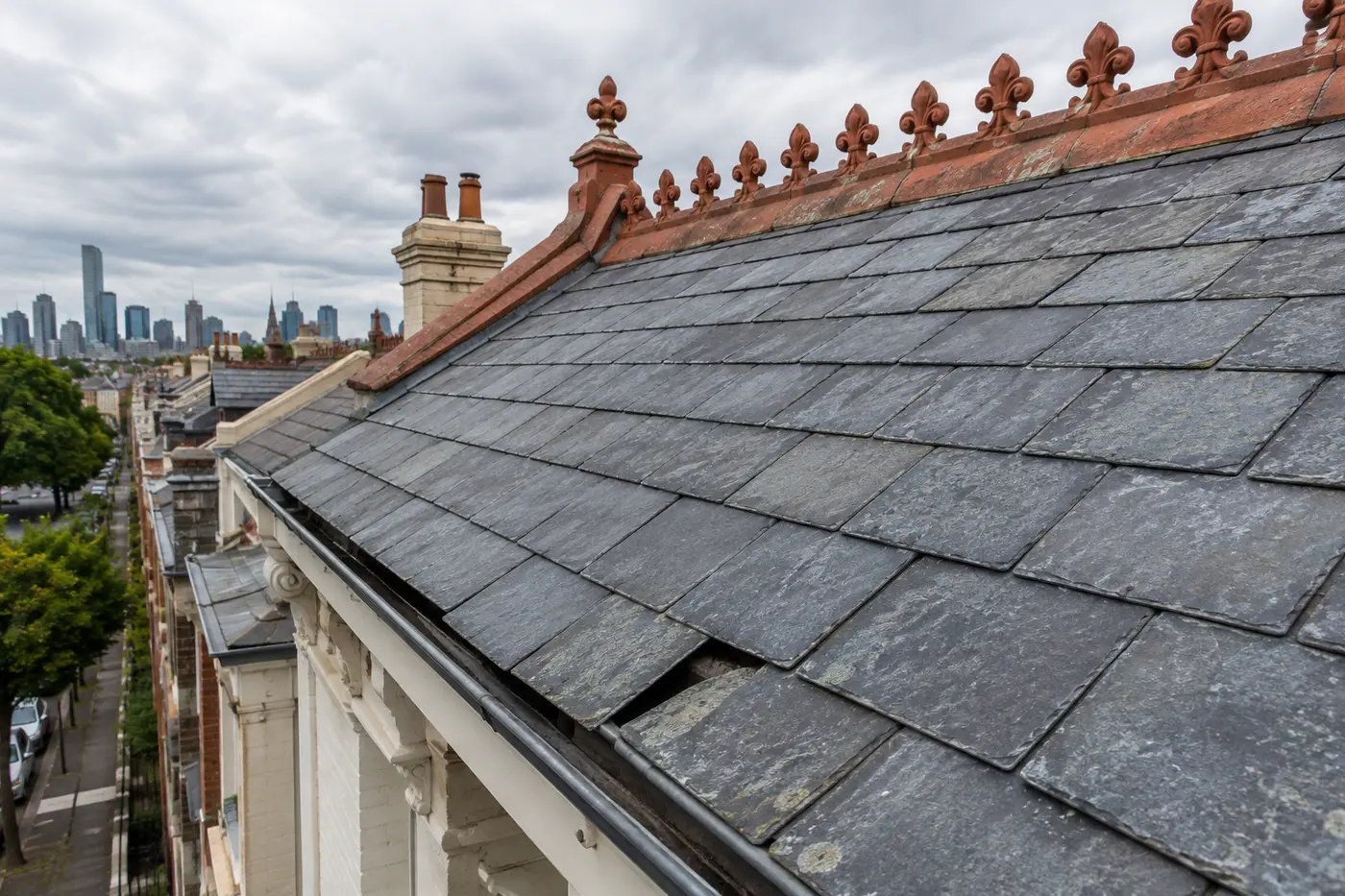
The call usually goes something like this. A brown stain has appeared on the ceiling of the front bedroom, the house is a Victorian terrace in Brunswick or Northcote, and someone has looked up from the footpath and noticed one of the grey slates sitting crooked. The owner wants to know two things: can it be fixed, and is the whole roof about to go? Most of the time the answers are yes, and no. Slate roof repair in Melbourne's inner north is usually a targeted job, not the start of a re-roof.
Slate is a different material from the terracotta and concrete tiles on most homes further north, and it fails in different ways. That changes what a good repair looks like. It is also why some of the fixes people get offered do more damage than the original problem.
Most slate roofs here are well over a century old
Natural slate went onto a lot of Melbourne's Victorian era homes. Plenty of the roofs we see in Brunswick, Northcote, Essendon and Moonee Ponds still carry the original Welsh or Australian slate laid between the 1880s and 1910s. Properly looked after, slate is about as close to a permanent roof as you can get.
What wears out is everything that holds it in place and keeps water out around it: the nails, the lead flashings, the valleys and the mortar on the ridges. So when a slate roof leaks, the slate itself is often not the thing that has failed.
Slate fails in two main ways, and only one involves the stone
Nail sickness: the slates are fine, the fixings are not
Each slate hangs from nails near its top edge. After a century of wet Melbourne winters, those nails corrode. Eventually one gives way and the slate slides down the roof, leaving a gap, or ends up in the gutter. Roofers call this nail sickness.
The giveaway is a slate sitting lower than its neighbours, or several slipped slates across one slope, while the stone itself still looks sound. One slipped slate is a simple fix. When the nails across a whole slope are going, though, putting back one slate at a time just means another one will follow before long.
Delamination: the stone itself splitting
Slate forms in thin layers, a bit like the pages of a closed book. Over many decades water can work into those layers, and individual slates start to flake, split or go soft at the edges. This is delamination. It tends to hit some slates and not others, depending on the quality of the original stone, so a roof with a few delaminating slates usually still has plenty of good ones on it.
The leak is often in the flashings, not the slate
On terrace homes, the parts we find failing most often are the joins. That means the lead flashings where the roof meets a chimney or a parapet wall, the valleys where two slopes meet, and the box gutters hidden behind a terrace parapet. If water is coming in near a chimney breast or a party wall, that is usually where we look first.
Chimneys deserve their own mention. A leaking chimney flashing is one of the most common causes of ceiling stains in Brunswick and Northcote terraces. On a house over 100 years old there are usually three weak points at once: the lead flashing around the base, the pointing on the brickwork, and the mortar collar at the top (called flaunching). All three typically need attention at the same time. Our guide to spotting failed roof flashing covers what lifted or cracked flashings look like.
What you can check without climbing up
Please don't get onto a slate roof to have a look. Slate cracks under a boot, it is slippery when even slightly damp, and these roofs are steep: pitches of 45 to 50° are common on double-fronted homes in Brunswick and Northcote. We work them with roof anchors and edge protection, and sometimes scaffolding, for good reason.
From the ground or an upstairs window, look for:
- a slate sitting out of line, lower than its row, or a dark gap where one is missing
- pieces of grey slate in the gutter, on the path or in a garden bed
- slates that look flaky, split or lighter at the edges
- lead flashing around the chimney that has lifted away from the brickwork
- stains on ceilings near chimneys, party walls or the front rooms
If an antenna or solar installer has been on the roof lately, check the area where they worked. Slate does not forgive being walked on, and broken slates often turn up exactly where someone stood.
A good slate repair replaces what failed and leaves the rest alone
We go over the roof slate by slate and replace only the ones that have actually failed. Replacements come from matching stock, natural or reconstituted slate, and are laid to the same lap pattern (how far each row overlaps the one below) and batten spacing as the original roof.
There is one practical wrinkle. A slate's nail holes are covered by the row above, so a replacement can't be nailed in the same way without disturbing its neighbours. It is usually held by a small metal clip, called a tingle, fixed to the batten and turned up to catch the bottom edge of the new slate. Done neatly, it is hard to spot from the street.
Around the slates, a typical repair also covers the lead flashings, the ridges and the valleys. Where heritage accuracy matters, ridges are repointed in a lime-based mortar rather than a modern product. The ornamental terracotta ridge cresting and finials on many Victorian rooflines get the same treatment: repointed and kept, not swapped for a modern profile. You can see the full scope of our heritage and slate roof repairs on the service page.
When nail sickness has spread across a whole slope, the usual answer is a bigger job. The slates on that slope are lifted, the fixings are renewed, and the sound slates go back on with matched stock filling the gaps. It costs more than spot repairs, but it is still a repair of your original roof rather than a replacement.
Never let anyone paint or coat a slate roof
This one surprises people. Some contractors will offer to restore a slate roof the way they would a concrete tile roof: pressure clean it and spray on a membrane coating. Say no. Slate needs to breathe. A coating traps moisture in the stone, speeds up the very decay it was supposed to stop, and cannot be undone. We don't paint slate, we don't overlay it with modern tile, and we don't suggest replacement when a targeted repair is the right call.
Heritage overlays usually allow like-for-like repairs
Large parts of Brunswick, Northcote, Essendon, Moonee Ponds and Ascot Vale sit within Heritage Overlay areas. Like-for-like repair and repointing generally goes ahead without a planning permit. Changing the material is another matter. Replacing slate with tile or metal where it can be seen from the street often needs council approval, and is frequently refused. We check what applies to your address before recommending anything, and your council's planning department can confirm whether your property is in an overlay.
Repairing slate costs far less than replacing it
We don't publish prices, because no two slate roofs are alike. Access is a big part of it. Steep pitches need anchors, edge protection and sometimes scaffolding, which adds a small cost and a little lead time. Beyond that, the price depends on how many slates have failed, how easy matching stock is to find, and whether flashings, valleys or box gutters need work at the same time.
What we can say is that re-fixing slipped slates and replacing the failed ones costs far less than re-roofing. It also keeps a roof that adds real character to a period home, and a well kept original slate roof usually does more for a terrace's value than any modern replacement would.
If you have spotted a slipped slate or a new stain near the chimney, get it looked at before the next heavy rain pushes more water in. Our inspections and written quotes are free. Book one through our slate and period roofing service and we'll tell you honestly what your roof needs.