
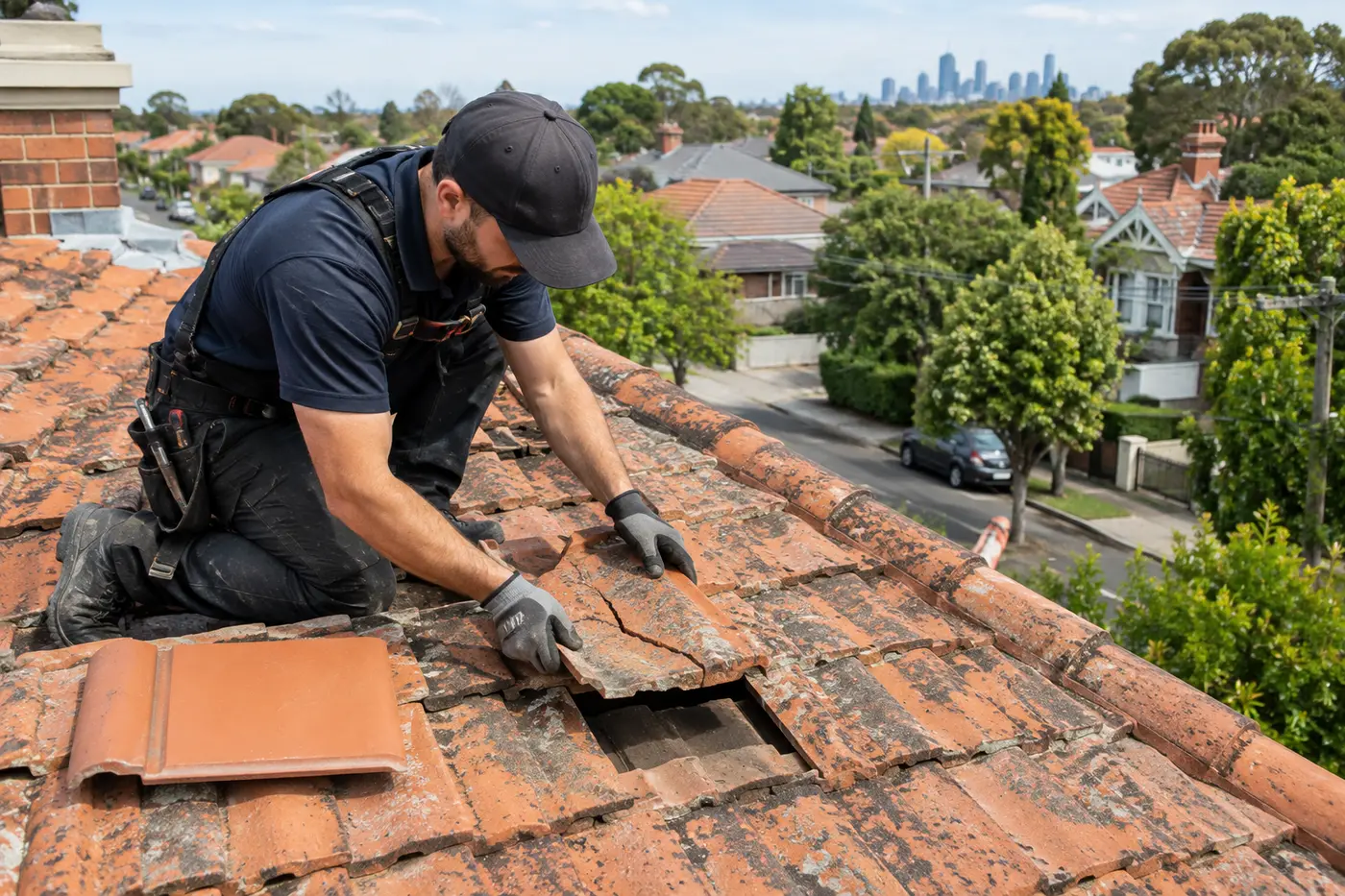
A windy night, and in the morning there's a curved shard of orange terracotta sitting in the garden bed. Or the solar installers have been and gone, and a week later you spot a tile on the back slope with a clean crack running through it. Neither feels like an emergency. Most of the time it isn't, yet. Cracked roof tile replacement is one of the smallest jobs we do, but it is also one of the easiest to put off until a winter storm turns it into a ceiling stain. This is what a cracked tile actually means for your house, why replacing one is rarely as simple as buying a tile, and what we check while we're up there.
One cracked tile won't sink a roof, but it doesn't stay small
Tiles work by overlapping. Each one sheds water onto the one below it, all the way down to the gutter. A crack breaks that chain. Rain runs straight through the gap and onto whatever sits underneath.
On a newer house, that is usually sarking: a reflective foil membrane laid under the tiles that catches stray water and carries it down to the gutter. On a lot of older homes in the inner north there is no sarking at all. Water goes straight onto the timber battens (the horizontal strips the tiles hang from) and then onto the top of your ceiling. A fine hairline crack might let in a few drops during a downpour. A tile with a corner snapped off lets in a steady stream, and it keeps doing it every time it rains, often for months before anything shows inside.
So the honest answer to "is a cracked tile a problem?" is this: not straight away, but it will be. The repair is quick while the damage is confined to the tile. It gets dearer once wet timber, stained plaster or a sagging ceiling join the list.
How tiles crack on northern suburbs roofs
The cause shapes the fix, so it is worth knowing which one you're dealing with.
Someone has been walking on it
This is the big one. Solar panel installers, antenna technicians, air conditioning installers and the odd well-meaning relative all walk on roofs, and tiles only take weight at certain points. Step in the wrong spot and a tile cracks under your boot. We often find a neat trail of cracked tiles running from the ladder to wherever the work was done.
Age and weather
The interwar bungalows through Preston, Coburg and Reservoir carry terracotta roofs that are now 80 to 100 years old. Terracotta that old has spent a long time soaking up rain and drying out again, and frost on cold mornings works into any existing weakness. Concrete tiles age differently. Across the 1960s and 70s housing in Bundoora, Watsonia and Greensborough, the surface coating wears away over time, the bare tile becomes porous, and a porous tile holds water that frost can then crack.
Hail and falling branches
Big hail is more of an outer north story, where the newer estates around Mill Park, South Morang and Craigieburn sit exposed to storms coming in off the northern plains. In the leafy streets closer in, a dropped branch from a mature street tree can crack several tiles in one hit.
Signs you can check from the ground
You don't need a ladder to get a fair idea. On a clear day, have a slow walk around the house and look for:
- pieces of tile in gutters, garden beds or on paths
- a tile sitting out of line with its neighbours, or a gap in a row
- one tile that looks darker than the rest, which can mean a crack is holding water
- a brown ring or damp patch on the ceiling after heavy rain
- daylight through the roof, if you can safely look into the roof space with a torch
Binoculars help. What they won't show you is a hairline crack, or damage on a slope you can't see from the yard, which is why the crack you've found is often not the only one.
Swapping a tile is easy. Matching one is the hard part.
Physically, replacing a single tile is quick. We lift the tiles that overlap it, slide the broken one out, check the batten underneath and fit the new one. The work that takes time is finding a tile that actually fits.
Tiles come in dozens of profiles, and many of the ones on older northern suburbs homes stopped being made decades ago. A modern tile that looks close from the street can have a slightly different curve or interlock, and if it doesn't sit properly it can leak just as badly as the cracked one did. Colour is the other catch. A new concrete tile will look noticeably brighter than its faded neighbours, and new terracotta rarely matches the weathered tone of a roof that has been up for generations. Our guide to how concrete and terracotta tiles differ as they age explains why.
Where a direct match isn't available, there are a couple of workarounds. Second hand tiles of the same profile are often the best fit on an old roof. On some jobs we move a sound original tile from a hidden spot to the visible damaged spot, and put the replacement where nobody will notice it. And on a concrete roof that is due for a recoat anyway, a colour mismatch stops mattering once the whole roof is coated.
What we check while we're up there
A cracked tile is a symptom, and whatever caused it often left other marks. When we come out to replace one, we look at:
- the tiles around it, since foot traffic and hail rarely damage just one
- the battens and sarking under the crack, for rot or tears
- the ridge and hip caps along the top edges, where cracked caps and crumbling mortar are common on older roofs
- nearby valleys and flashings, if water has been tracking somewhere unexpected
Cracked ridge caps are a slightly different job from cracked tiles on the main roof surface. Caps sit on a bed of mortar, so replacing one means lifting it, clearing the old bed and setting the new cap in fresh bedding before it is sealed with flexible pointing. We handle cracked tiles, slipped tiles and the mortar work at the ridges as part of our tile roof repair service, and we can usually tell you on the day whether it is a one tile fix or something bigger.
Silicone over a crack is a stopgap, not a repair
We see plenty of cracked tiles with a smear of sealant over the top. Sometimes it stops the drip for a season. But sealant breaks down in the sun, the crack keeps moving as the tile heats and cools, and water often finds its way around the patch and keeps soaking the battens out of sight. If a patch is all that's possible before a storm, fair enough. Plan to have the tile properly replaced soon after.
When a few cracked tiles point to something larger
A handful of broken tiles from one install or one storm is a straightforward repair. Cracked tiles scattered across every face of the roof are a different picture. So are tiles that crumble when they're handled, or a roof where the ridges, valleys and tile surface are all wearing out at once. At that point replacing tiles one by one stops being good value, and the real question becomes whether to restore the whole roof or replace it. We've written about how to tell which of those your roof needs.
The age of the house is a decent first clue. A newer concrete roof in the outer north with three tiles cracked by an installer almost always just needs those three tiles. A century old terracotta roof in Coburg with cracks appearing on every slope is telling you something else.
Please leave the ladder in the shed
Tile roofs are slippery, and cracked or porous tiles can give way underfoot without warning. Walking on the roof to look at one broken tile is a common way to end up with several more, or with a fall. Look from the ground, take photos of anything you notice, and if water is coming inside, put a bucket under it and move valuables out of the way until someone can get up there safely.
Get it looked at before the next big rain
If you've spotted a cracked tile, a slipped tile or pieces of tile in the garden, the best time to deal with it is before water has had months to work on the timber underneath. We offer free inspections and quotes across Melbourne's northern suburbs, and we'll tell you plainly whether you need one tile or something more. Book a visit through our roof repairs page or call us on (03) 9498 1000.