
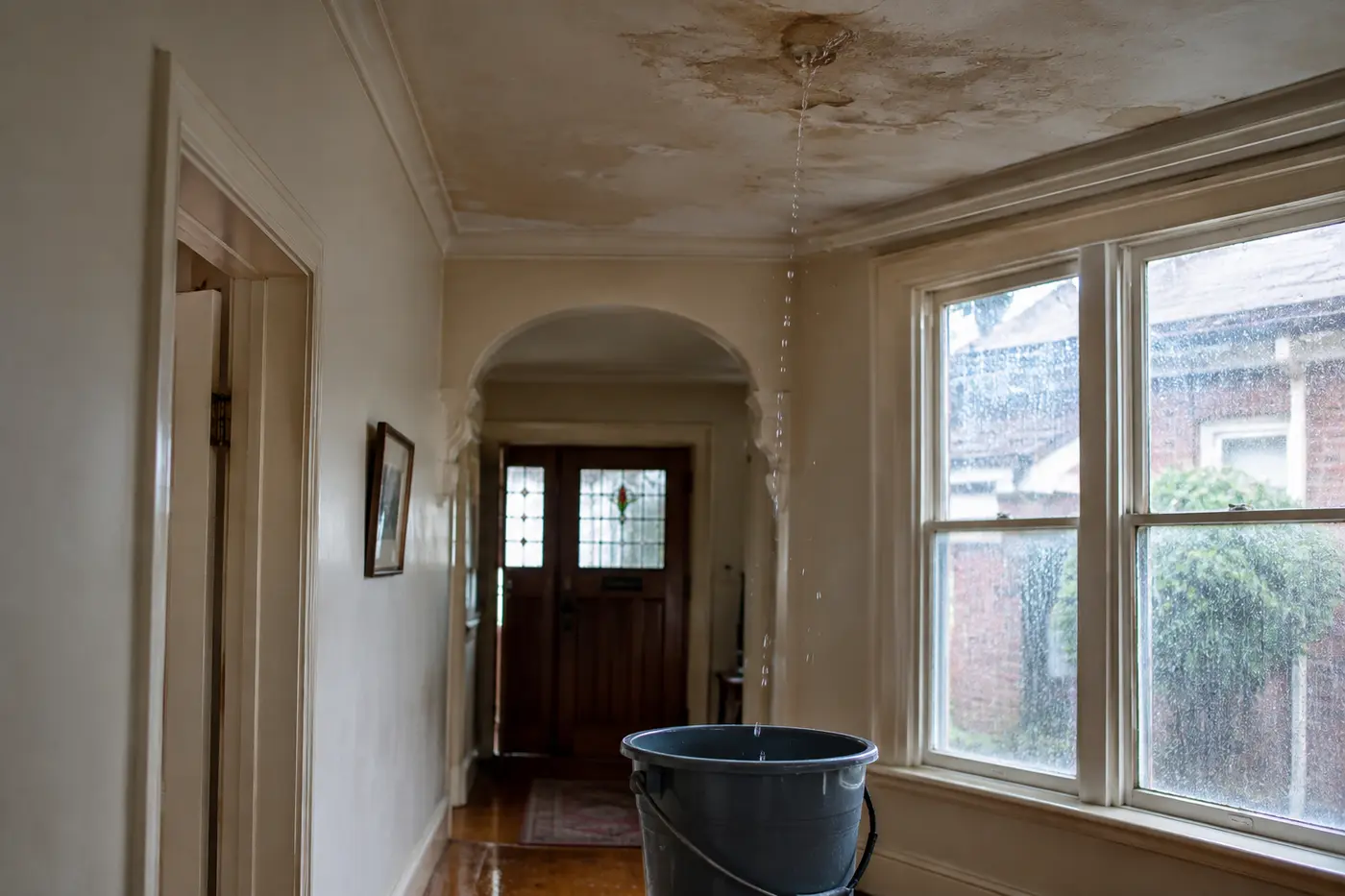
It's late, the rain has been hammering down for an hour, and you hear it before you see it: a steady drip somewhere in the hallway. Then you find the brown patch on the ceiling, and the puddle under it. If you're searching for emergency roof leak repair right now, the good news is that the next hour matters far more than the next five minutes. What you do inside the house tonight decides how much damage there is to fix tomorrow.
We take these calls all through winter and every time a spring storm rolls across the north. Here's what we tell people on the phone, in the order we tell them.
Check for electrical danger before anything else
Water and wiring meet in the ceiling. If the drip is coming through a light fitting, a downlight or an exhaust fan, or anywhere near a power point, turn that circuit off at the switchboard. If you can't tell which circuit it is, or the switchboard itself is wet, turn off the main switch and call an electrician.
Then look at the plaster. A stain is one thing. A ceiling that is bulging, sagging or making cracking sounds is holding a lot of water, and plaster can let go without much warning. Keep everyone, pets included, out from under it and close the door to that room if you can.
Contain the water inside, not on the roof
Once it's safe, the job is simply to stop the water spreading. A bucket under the drip, towels around it to catch the splash, and anything that can be moved shifted out of the way. Roll up rugs. Lift electronics and boxes off the floor. On timber or laminate floors, a sheet of plastic under the bucket helps, because water that seeps between boards does slow, expensive damage.
If you have a manhole and a torch, a quick look into the roof space from the top of a steady ladder can tell you a lot. You may see a wet trail on the timber or the sarking (the foil or fabric layer under the tiles) leading back uphill. Don't climb into the roof space and walk around. Ceiling joists are narrow, and stepping between them puts a foot through the plaster.
Stay off the roof until it's dry
This is the one we repeat most, because it's where people get hurt. Wet tiles have almost no grip. Across Preston, Coburg and Reservoir, a lot of homes still carry terracotta tiles that are 80 to 100 years old, and old terracotta cracks underfoot even in the dry. Wet Colorbond is just as slippery. Add wind, poor light and a ladder on soft ground, and it's a genuinely dangerous place to be.
It also tends not to work. Sealant from a hardware store tube won't bond to a wet surface, and you're guessing at where the water is getting in. Water often enters a metre or more away from where it drips, so the spot above the stain is frequently the wrong spot.
Photos now save arguments later
Before you mop up, take photos and a short video of the drip, the stain, the bucket and anything that got wet. Note the date and time. If you end up making a claim, insurers want to see what happened and when, and it's much harder to show that once everything is dry and tidied away. Keep any damaged items rather than throwing them out straight away.
Whether a leak is covered usually comes down to the cause: a storm event is treated very differently to a roof that has worn out over time. We've written a separate guide on when home insurance covers a roof leak if you want to understand that before you ring your insurer.
Who to call depends on what you're dealing with
If the storm has done serious damage, such as a tree branch through the roof, sheets of metal lifted or tiles stripped off a whole section, and it's not safe to wait, call VIC SES on 132 500. They handle storm emergencies and can put a temporary cover on to protect the house.
For the far more common situation, a leak that's bad but contained in a bucket, call a roofer. Our hours are Mon to Fri 8:00am to 5:00pm and Sat 8:00am to 12:00pm, and the first thing we'll ask is where the water is showing up, when it started and what kind of roof you have. That helps us work out whether it needs someone on the roof the moment the weather allows.
An emergency repair is usually a make-safe first
Most people picture the leak being fixed in one visit. Often it happens in two steps. The first visit, once it's safe to get up there, is about stopping the water: refitting slipped tiles, swapping out a cracked one, clearing a valley or gutter that has dammed up, or sheeting over a damaged section until it can be repaired properly.
The second step is the permanent fix, done in dry weather when sealants and mortar can actually cure. On northern suburbs homes, the cause we find is usually one of a handful of things:
- valleys and gutters blocked with leaf litter from mature street trees, so water backs up under the tiles
- fretting ridge pointing, which loosens the ridge caps and lets wind-driven rain straight in
- tiles cracked by hail or by someone walking on them
- lifted or rusted flashing around chimneys, walls and skylights
That second visit is ordinary roof leak repairs: finding the real entry point, fixing it properly and checking the rest of the roof for the next weak spot. If the leak has a habit of only showing up in certain weather, our guide on tracing a winter leak back to its source explains why the stain and the cause are rarely in the same place.
The drip stopping doesn't mean the leak is fixed
When the rain eases, the drip stops and the urge to forget about it is strong. The trouble is that water has already soaked into insulation, battens and plaster, and the gap in the roof is still there for the next downpour. Leaks left for months lead to sagging ceilings, rotting timber and mould in the roof space, and each of those makes the eventual repair bigger.
A leak that keeps coming back in different spots is also telling you something. When the valleys, the ridge pointing and the flashings are all the same age, they tend to fail around the same time. At that point, chasing one leak after another costs more than dealing with the roof as a whole, and an honest inspection will tell you which side of that line you're on.
Get the leak looked at while it's fresh
Once the water is contained and the weather allows, the sooner someone gets on the roof, the clearer the cause usually is. We offer free inspections and quotes across Melbourne's northern suburbs, and we'll tell you plainly if a small fix will do or the roof needs something bigger. Talk to us about getting your roof leak repaired properly before the next big rain arrives.