
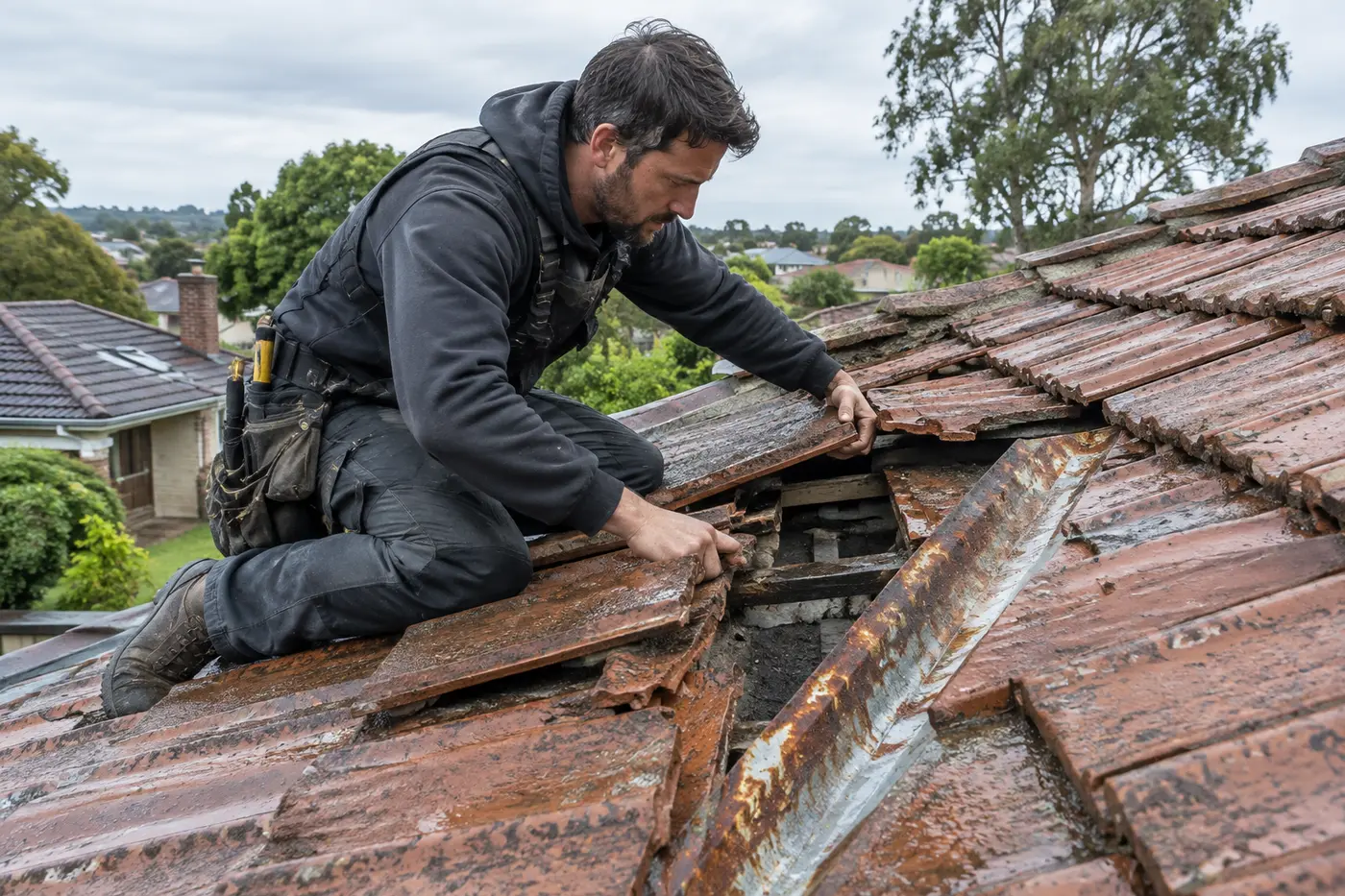
It usually starts with a sound. A slow tap in the hallway at 2am, and by morning there's a bucket on the carpet and a brown ring spreading across the plaster. Once the bucket is in place, the next question is always the same: how much is this going to cost? It's the first thing most homeowners ask us, from Reservoir, Preston, Essendon and right across the north. The honest answer is that leaking roof repair cost in Melbourne depends far less on how bad the stain looks and far more on what is actually letting the water in.
We don't publish a price list, and we won't give you a figure over the phone. That isn't us being cagey. A leak from one slipped tile and a leak from a rusted valley look identical from inside the house, and they are completely different jobs. What we can do is explain how a leak repair gets priced, so the quote you receive makes sense and you can tell a fair one from a vague one.
The cause sets the price, not the size of the stain
A small stain can hide an expensive problem. A dramatic drip can turn out to be a quick fix. Water rarely falls straight down: it runs along the sarking (the waterproof membrane under the tiles), along battens and ceiling joists, and drops wherever it finds a low point. The entry point can be metres from where it shows on your ceiling.
So a leak repair is really two costs added together. Finding the source, and fixing whatever that source turns out to be. Anyone who quotes before they've been on the roof is guessing at both.
Finding the leak is part of the job
On most jobs the diagnosis is the part that takes skill. We start on the roof, not under the stain, and work back along the path the water has taken. Sometimes it's obvious within minutes, like a cracked tile with a clear watermark beneath it. Other times it means checking the roof space, lifting tiles near a valley or looking closely at how a flashing meets a wall. If you'd like to see how that tracing works, our guide to tracking down a winter roof leak walks through where water usually gets in on homes around here.
This is also why the inspection matters so much. Ours are free and come with photos of what we found, so you can see the problem yourself instead of taking our word for it.
Most leaks come from a handful of places
Across Melbourne's north, the same few culprits turn up again and again. Here they are, roughly from the simplest repair to the most involved.
A cracked or slipped tile
The smallest job. Hail, a fallen branch or foot traffic on brittle old tiles can crack one, and a slipped tile leaves a gap open to the weather. Replacing a few tiles with matching ones is usually a short visit. The catch on older homes is matching: some interwar terracotta profiles in Preston, Coburg and Reservoir are no longer made, so sourcing the right tile can take longer.
Fretting ridge capping mortar
The ridge caps along the peak of a tile roof sit in mortar. On interwar and postwar homes the original cement mortar cracks under Melbourne's cold winter nights, then crumbles, and water finds its way in under the caps. It's the single most common repair we do on the older tile roofs of the inner north. If only one section has gone, it can be repointed on its own. If the whole ridge line is fretting, rebedding and repointing all of it is the lasting fix, and the price grows with the length of ridges and hips involved.
Flashings around chimneys, walls and vents
Flashing is the metal strip that seals the joint where your roof meets something else: a chimney, a brick wall, a vent pipe. Those joints move, sealant dries out, and old flashings rust or lift. Resealing a flashing is a modest job. Replacing one, particularly around a chimney, takes more time and material.
Skylights
Ageing skylights are a regular source of drips. Sometimes the fix is resealing or new flashing around the unit. If the skylight is old, cracked or has already been patched before, replacing it can be better value than paying for yet another repair.
Valleys
A valley is the channel where two roof slopes meet, and it carries a lot of water in heavy rain. When an old valley iron rusts through, or the tiles beside it are poorly bedded, water goes straight into the roof space. A leaking valley is urgent. Replacing one is a bigger job than a tile swap because the tiles along both sides have to come up and go back down properly.
Rust on a metal roof
On the Colorbond and steel roofs common in Craigieburn, Mill Park and South Morang, leaks tend to start at screw holes, seams and flashings. Surface rust caught early is a spot repair: treated, primed and coated. Rust that has eaten through a sheet means replacing that sheet.
Four things that move a quote up or down
Once the cause is clear, a few practical things decide where the price lands.
Height and access. A single-storey bungalow with a clear driveway is quick to get onto. A two-storey home, a house tight against the boundary, or a roof that needs edge protection to work on safely takes more time and equipment.
Pitch and roof type. The steep roofs and slate on Victorian and Edwardian terraces around Brunswick and Northcote are slower, more careful work than a low concrete tile roof in Bundoora or Greensborough.
Matching materials. Common tiles and standard Colorbond colours are easy to source. Discontinued profiles and heritage materials are not.
How long it has been leaking. This is the one people underestimate. A leak that has run for months can rot battens and soften ceiling plaster. Fixing the roof stops the water, but repairing a damaged ceiling is a separate job, usually for a plasterer, and it adds to the total cost of the leak. Getting onto it early is the simplest way to keep the bill down.
When a patch stops making sense
Most leaks are a single fault, and one targeted repair is the right answer. We would much rather fix the actual problem properly than talk you into a bigger job you don't need.
Some roofs, though, leak in one spot because they're wearing out everywhere. If we find fretting mortar along every ridge, plenty of cracked or porous tiles, and you've already had two or three leaks fixed in recent years, paying for one patch after another adds up. At that point a full restoration, which handles the cleaning, rebedding, repointing and coating in one go, is usually the better spend. We'll show you the photos, tell you which situation you're in, and leave the decision with you.
Why the cheapest fix often costs more
A tube of silicone smeared over a cracked tile or around a flashing will often stop a drip for a while. It rarely lasts. Sealant breaks down in the sun, the real fault is still there, and the next big storm brings the bucket back out. In the meantime, water keeps soaking into timber and plaster you can't see.
A proper repair uses the right material for the job: matching tiles, flexible pointing compound on ridges, new flashing instead of more sealant. It costs more on the day than a quick patch and less than paying twice. Our roof leak repairs are quoted at a fixed price for the specific fix after an inspection, and if the repair doesn't hold after rain, we come back and find what we missed at no extra charge.
Insurance may cover it, depending on the cause
If the leak started because of a specific event, such as hail, a storm lifting tiles or a branch coming down, your home insurance may pay for the repair and the water damage inside. If the cause is age and wear, like crumbling mortar or a valley that has rusted over many years, insurers usually say no. It helps to know which side of that line you're on before lodging a claim, and our post on whether insurance pays for a roof leak goes through it in more detail. Either way, photos from an on-roof inspection make the conversation with your insurer much easier.
What a fair leak repair quote should tell you
When a quote arrives, check it against a few simple questions:
- The actual cause, named, not just "fix leak"
- Photos taken on the roof, not only of the ceiling
- Which materials will be used
- Anything else spotted that will need attention soon, so there are no surprises next winter
A quote that covers all of that can be compared honestly against another one. A single line and a number can't.
Got a drip, a stain or a bucket in the hallway? We inspect and fix leaking roofs across Melbourne's northern suburbs, from Reservoir and Preston to Essendon, Craigieburn and Eltham. Book a free inspection with our roof repairs team and we'll find the source, show you the photos and give you a fixed price before any work starts. Call (03) 9498 1000.