
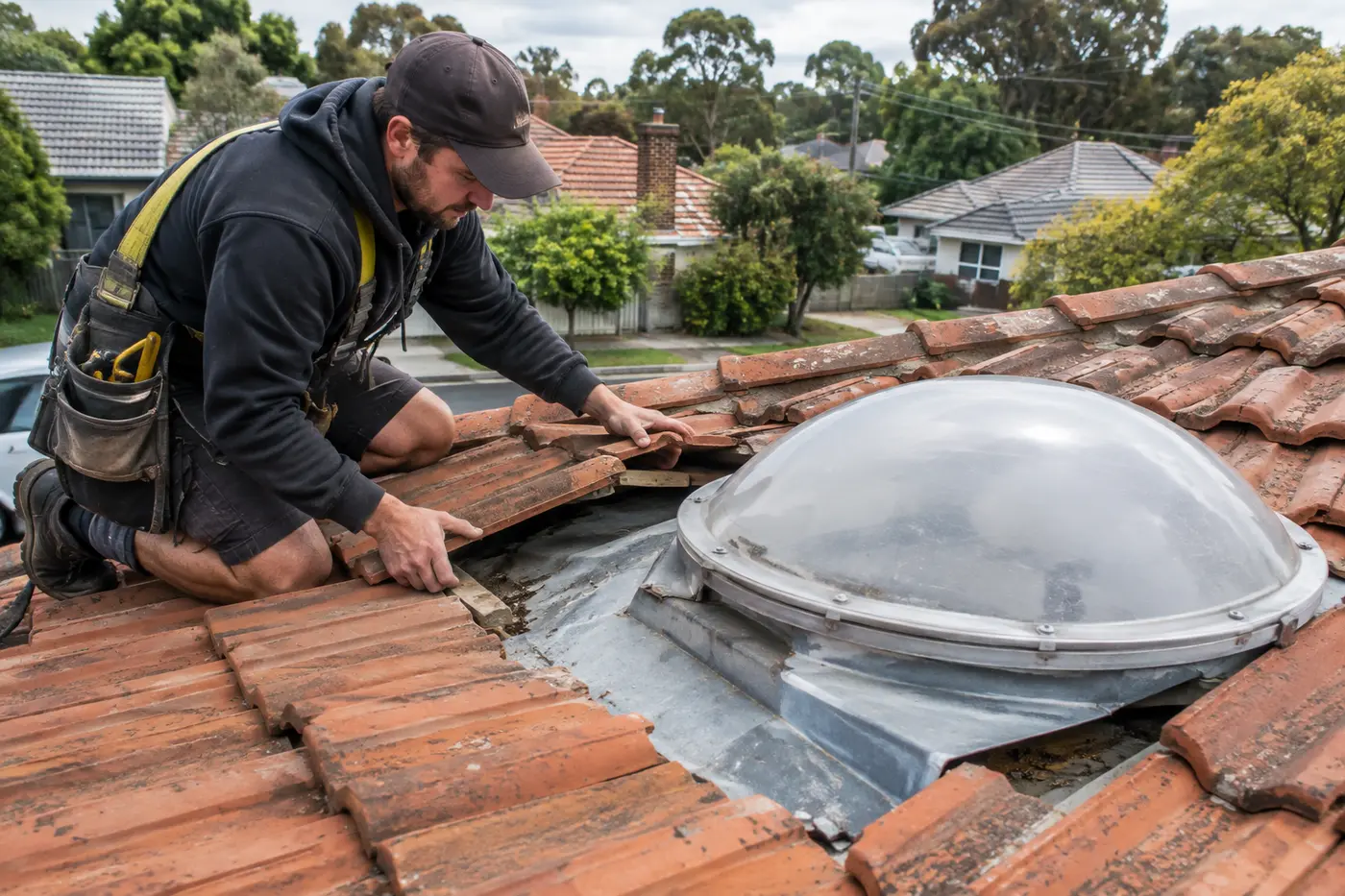
The stain is almost always in the worst spot. A dark ring on the plaster beside the skylight in the family room, or a drip that lands on the kitchen floorboards every time it rains hard. Most people who call us assume the skylight itself has broken. Usually it hasn't. Leaking skylight repair is more often about the seals and metal around the unit than the dome or glass, and that difference decides whether you need a reseal, new flashings or a whole new skylight.
Here is how we work out which one, and what each fix involves, on the homes we see across Melbourne's north.
Water gets in at one of three points
Nearly every skylight leak we find comes from one of three places.
The flashing. This is the metal that seals the gap between the skylight frame and the tiles or sheets around it, and it is the most common failure point by a long way. Flashings are set with sealant, and that sealant dries out and cracks, typically within 15 to 20 years. Once it does, rain runs in at the edge of the frame.
The glazing seal. The rubber or butyl strip between the dome (or glass) and the frame. Sun and the daily swing between hot and cold wear it down until water can track in behind the dome.
The dome or glass itself. A crack lets water straight through. It is the least common of the three, and the easiest to spot.
Getting this right matters because fixing the wrong one does nothing. We regularly find skylights with fresh sealant smeared around the dome while the real problem is a lifted flashing on the uphill side, still letting water in with every storm.
The stain doesn't always point to the problem
Skylight leaks often show up well after the rain has stopped. Water that gets behind the dome or under a flashing takes time to travel, and it can run along the light shaft or a ceiling joist before it drips. So a stain on one side of the skylight doesn't mean the leak is on that side.
A few clues do help. If the drip only appears in rain from one direction, especially wind driven rain, the water is usually getting in at one specific point, most often where the flashing meets the roof on the uphill side. If water beads on the inside of the dome on cold mornings with no rain at all, that can be condensation rather than a leak, which is a different problem with a different fix. And if the leak started straight after a hailstorm, the dome is the first thing we check for cracks.
Reseal, reflash or replace: how we decide
We start with the smallest repair that will actually stop the water. On an inspection we look at the frame, the flashings, the glazing seal and the dome, plus the tiles or sheets around them, then recommend one of three fixes.
Resealing the glazing
If the frame and flashings are sound and the water is coming through a perished edge seal, the old seal comes out and the dome or glass is rebedded with a suitable butyl or polyurethane sealant. It is the smallest of the three jobs. A bead of silicone run over the top is not the same thing, and it tends to fail again.
Replacing the flashings
When the flashings have cracked, lifted or rusted, they need replacing rather than patching. That means lifting the tiles around the skylight, fitting new curb and apron flashings (the pieces that wrap the sides and the bottom edge of the frame), then putting the tiles back properly. Flashing work is roof plumbing, and if you want the bigger picture on how flashings fail across the rest of a roof, our guide to flashing problems and how they're fixed covers it.
Replacing the whole skylight
Sometimes the unit is past saving. A corroded or cracked frame, a dome that has gone yellow or crazed with fine cracks, or a skylight that has already been repaired twice and still leaks. In those cases a new unit is usually better value than another repair. We take the old one out completely, fit the new skylight, and do all the flashings and tile reinstatement as part of the same job. A new skylight fitted correctly shouldn't need attention for another 20 to 30 years.
Our skylight leak repair and replacement service covers all three, and we'll tell you which one your skylight actually needs once we've been up on the roof.
Most repairs take half a day to a full day
A straightforward reseal or flashing replacement typically takes half a day to a full day. A full skylight replacement, including putting the tiles back, is usually a full day's work. Both need a dry day, because the roof is opened up around the skylight while the work is done.
Older homes in the north have their own skylight quirks
Plenty of the skylights we see were added years after the house was built. On the interwar bungalows of Preston, Coburg and Reservoir, a skylight was often cut into a terracotta roof that is now 80 to 100 years old, and the tiles around it can be brittle. Matching a broken one can take time too, because some older terracotta profiles are no longer made.
Around Bundoora, Watsonia and Greensborough, the 1960s and 70s concrete tile homes often still have their original skylight flashings. They tend to wear out around the same time as the ridge pointing, so it is worth having both looked at together.
In Craigieburn's newer estates the roof is usually Colorbond, and the weak spot is where the skylight is flashed into the metal sheeting. Builder grade flashing failures are common on these homes, and hail coming across the northern plains can crack a dome outright.
In streets with big trees, leaf litter is the other culprit. Leaves pile up on the uphill side of a skylight and hold water against the flashing, which is exactly where you don't want it sitting.
What to do until it's fixed
Keep it simple and stay off the roof. Put a bucket or towels under the drip, move rugs and furniture out of the way, and if water is coming near a light fitting or downlight, switch that circuit off at the switchboard. Take dated photos of the stain and any water on the floor. If the leak started after a storm, those photos matter if you decide to claim, and our post on whether home insurance pays for a roof leak explains how insurers usually look at it.
Try not to wait for it to dry out and hope. Water that has been getting in around a skylight for a few months can soften the plasterboard in the light shaft and stain the ceiling well beyond the original mark, which turns a skylight repair into a ceiling repair as well.
A free inspection tells you which fix you need
We inspect for free, take photos of what we find, and give you a fixed written quote for the repair your skylight actually needs, whether that's a reseal, new flashings or a replacement unit. Call us on (03) 9498 1000 or send through a request from our skylight repairs page.