
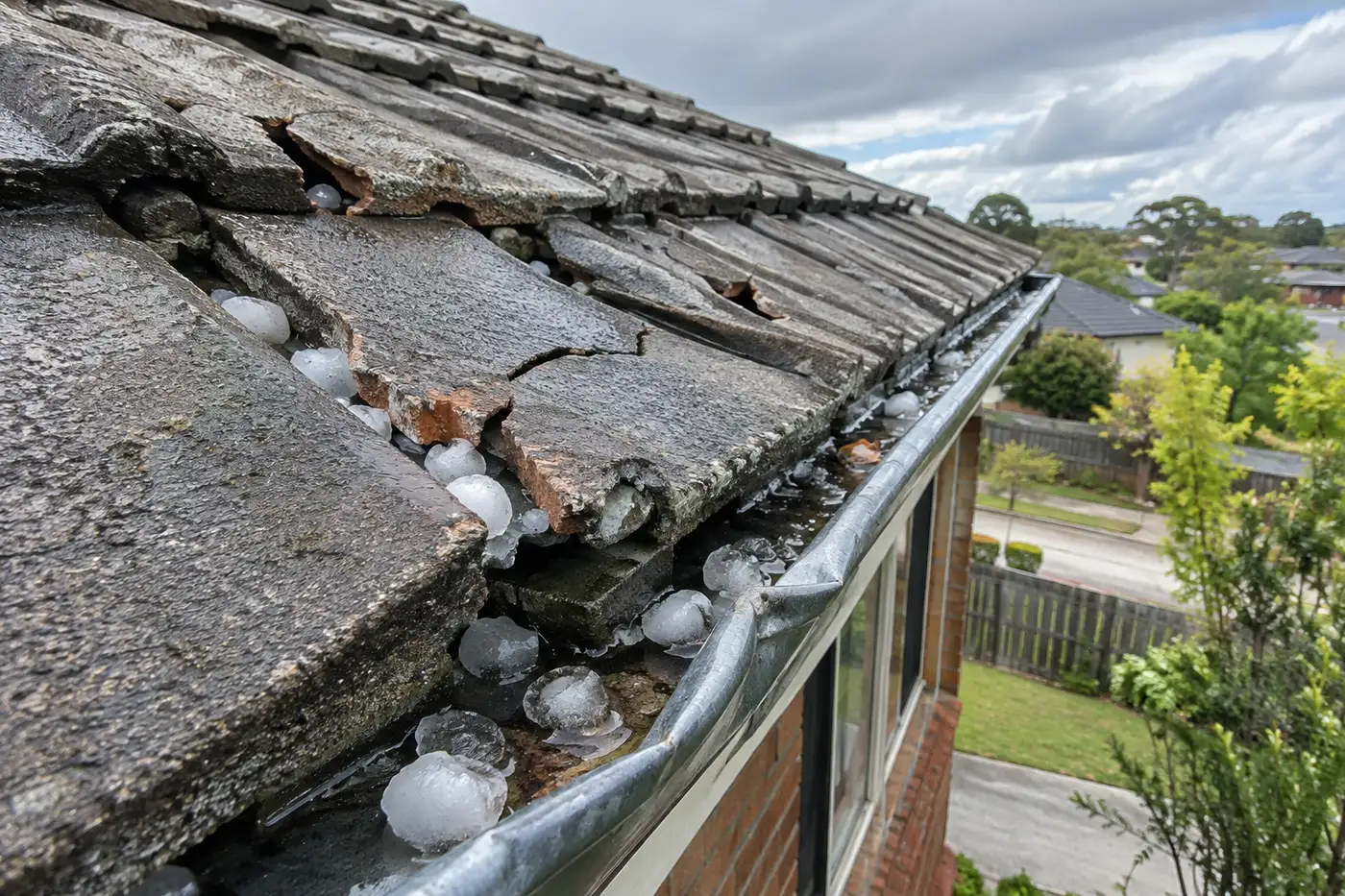
The storm comes through in a few minutes. It sounds like gravel being tipped onto the house, then it stops, and the backyard is white. Once the noise dies down, most people walk outside, look up at the roof and see nothing obviously wrong. That's the tricky part about roof hail damage. The worst of it is often invisible from the ground, and it may not announce itself until the next big downpour, sometimes weeks later.
We get these calls every spring from across Melbourne's north. Here's what hail actually does to the roofs around here, what you can safely check yourself, and why it pays to get the roof looked at while the storm is still recent.
Hail damage often stays hidden for weeks
A hailstone hitting an old tile doesn't always break it in two. Often it leaves a hairline crack you couldn't see from a ladder, let alone the lawn. The tile stays in place and looks fine. Then a heavy rain arrives, water gets driven through the crack, and a brown stain shows up on a bedroom ceiling a month after the storm.
By then a lot of people don't connect the two events. That matters for two reasons. The water has had weeks to soak into insulation, battens and plaster. And if you end up making an insurance claim, a leak that appears long after the storm is harder to tie back to it.
Tiles and Colorbond fail in very different ways
What hail does to your roof depends mostly on what the roof is made of. Across the north we see the full range, so it's worth knowing which camp you're in.
Terracotta and concrete tiles crack, chip or break
Tiles are hard but brittle. A big enough hailstone cracks them, knocks corners off or punches a hole straight through. Age makes this much worse. The interwar bungalows in Preston, Coburg and Reservoir often carry terracotta tiles that are 80 to 100 years old, and old terracotta doesn't take a hit the way it did when it was new. The concrete tile roofs through Bundoora, Watsonia and Greensborough, and on the 1980s to 2000s estates around Mill Park and South Morang, chip and crack too.
Broken pieces don't always stay put either. They slide down into valleys and gutters, where they can trap water and leaf litter. Ridge caps (the rounded tiles along the peak of the roof) can crack as well, and a cracked cap is an easy way in for wind-driven rain.
Colorbond dents, but rarely cracks through
Metal roofs handle hail far better. Colorbond dents under a heavy hailstone, but it doesn't crack through the way a tile can, which is a big part of why Colorbond has become the usual choice on the newer estates in Craigieburn.
That doesn't mean a metal roof always comes through untouched. On metal roofs it pays to look past the big sheets to the parts around them: flashings (the folded metal strips that seal joins against walls and around pipes), gutters, downpipes and roof vents. Thin gutters and whirlybirds dent easily. A dented sheet that still sheds water is mostly a looks problem. A damaged flashing is a leak waiting to happen.
Skylights take a beating
Older plastic skylight domes can crack or shatter in a decent hailstorm, and the flashing around them can get knocked about. If you have a skylight, give it a proper look from inside once the storm has passed.
What you can check without leaving the ground
You can learn a fair bit without going anywhere near a ladder. Once the storm has cleared and it's safe to be outside, have a look at:
- Gutters, paths and the driveway, for pieces of broken tile
- Gutters, downpipes, the meter box and outdoor furniture, for fresh dents (a good guide to how hard the hail hit)
- Ceilings, especially near skylights, chimneys and external walls, for any new damp patches
- The roof space, with a torch from the manhole only, for wet timber or daylight showing through
Take dated photos of anything you find, along with a few of the hail itself if it's still lying around. It feels like overkill at the time. It rarely is.
What you shouldn't do is climb up for a closer look. Tiles are slippery after rain and hail, damaged tiles break further underfoot, and a fall from roof height is a far bigger problem than a cracked tile. Walking on a hail-damaged tile roof can also turn a few cracks into a lot more of them.
Why the outer north tends to cop it worst
Spring storms that roll in off the northern plains hit the growth corridor harder than most of Melbourne. Craigieburn, Mill Park and South Morang sit right in that path, and some of the most significant hail events in metropolitan Melbourne land there. Further in, the hail may be less frequent, but the roofs are older and the tiles more brittle, so a moderate storm can still do real damage to a century-old terracotta roof in Preston or Coburg.
Get the roof checked while the storm is still recent
An inspection in the days after a significant hailstorm does two jobs. It finds the cracks you can't see from the ground before the next rain finds them for you. And it creates a record of the damage that is clearly linked to a specific event.
That second part matters more than people expect. Insurers generally treat damage from a sudden event like hail very differently to a roof that has simply worn out, and on older roofs the argument is often about which one caused the problem. A report written soon after the storm, with photos taken on the roof, makes that case far stronger. Our guide on what home insurance will and won't pay for goes through the claims side in more detail.
Our inspections and quotes are free, and we photograph what we find, so you can see the damage for yourself instead of taking anyone's word for it. If someone you didn't call knocks on your door after a storm offering to fix the roof on the spot, there's no harm in saying you'll get it inspected first.
Most hail damage is a repair, not a new roof
If the storm has cracked a handful of tiles, the fix is replacing those tiles with matching ones and checking the ridge caps and valleys while we're up there. That's everyday tile and roof repair work, and on most homes it's a short job. The one catch on older houses is matching. Some interwar terracotta profiles are no longer made, so finding the right tile can take a little longer.
On a Colorbond roof, dented sheets that still shed water can usually stay where they are. Damaged flashings, gutters or vents get replaced.
Occasionally the damage is too widespread to patch. When cracked and broken tiles run right across the roof, replacing them one by one stops making sense, and a new roof becomes the honest answer. Some owners take that as the moment to switch from tile to Colorbond for better hail resistance. If you're weighing that up, our comparison of restoring versus replacing a roof explains how we make the call. Our roof restorations and replacements come with a 10-year written guarantee on workmanship and materials.
Had hail come through your street? We inspect hail-damaged roofs across Melbourne's northern suburbs, from Craigieburn and Mill Park to Preston, Reservoir and Coburg. Book a free inspection with our roof repairs team and we'll show you the photos, tell you plainly what needs fixing, and give you a fixed price before any work starts. Call (03) 9498 1000.