
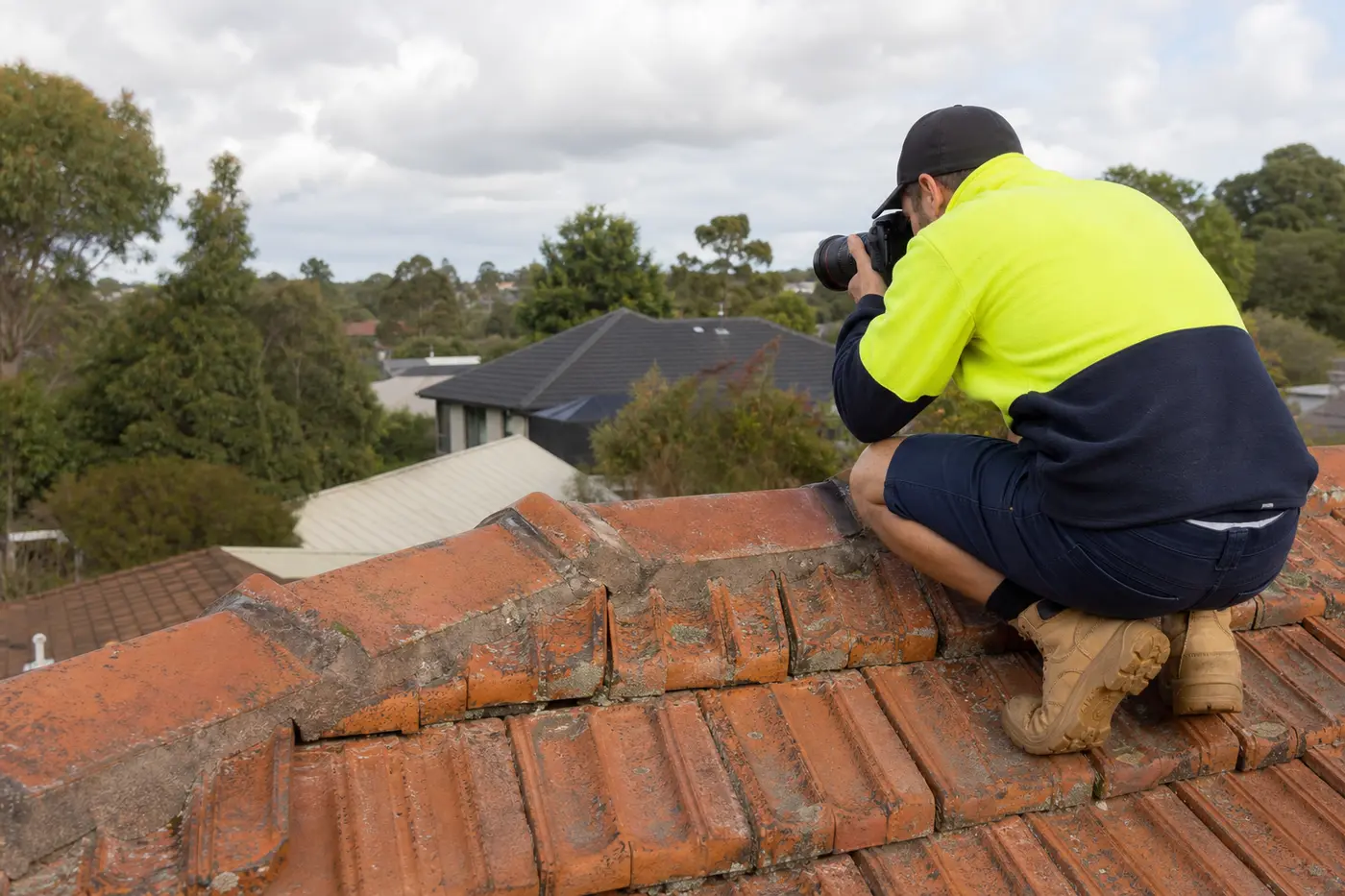
A brown ring appears on the hallway ceiling after a wet week. Or you're about to sign for a house in Preston and the roof looks fine from the footpath, but you have no real idea what's going on up there. Or a storm has just been through and half the street is on the phone to a roofer. These are the three moments people usually go looking for a roof inspection in Melbourne, and in all three the same thing is true: the roof holds the answer, and you can't see the roof from the ground.
Most of the homes we look at across the northern suburbs are brick-and-tile places 20 to 40 years old. From below they can look completely sound while the ridge caps are lifting, the valleys are rusting through, or the pointing has quietly crumbled away. A proper inspection is just someone qualified getting up there, looking closely, and telling you the honest state of it before a small problem turns into a wet ceiling.
Looking up from the driveway tells you almost nothing
The most common thing we hear is "it looks alright from here." It nearly always does. The parts of a roof that fail first are the parts you cannot see standing on the lawn: the mortar under the ridge caps, the flashings where the roof meets a wall or chimney, the valleys that carry water down between two roof faces, and the underside of tiles that have started to crack or slip. A drone photo from above helps, but it still can't lift a tile, press on soft timber in the roof cavity, or check whether a flashing is actually sealed or just sitting there looking the part.
That's why an inspection worth having is done in two halves. Outside, we walk the roof and check the tiles or sheets, the ridge capping, the flashings, the valleys, and the gutters and their fall. Inside, we get into the roof cavity with a light and look for the real evidence: water stains on the timber, damp insulation, daylight where there shouldn't be, and the tell-tale trails that show where water has been getting in. A leak almost never drips straight down from where it enters. Tracing it properly is half the job.
The three times it's worth booking one
There are really three situations where a roof inspection earns its keep.
Before you buy. A standard building inspection walks the property and glances at the roof, but it rarely includes someone getting up onto it and into the cavity. On an older northern-suburbs home the roof can be the single most expensive thing to put right, so knowing whether it has five good years left or needs work now is worth a lot at the negotiating table.
After a storm. Melbourne's north cops wind coming off the northern plains and the odd hail event, and both crack and shift tiles in ways you won't spot until the next downpour finds the gap. A check straight after gives you a written record of any damage, which matters if you end up making an insurance claim.
As a regular health check. If your roof has never been looked at and it's getting on in years, a check every few years catches the cheap fixes while they're still cheap. Repointing a ridge is minor money. Replacing timber that has rotted because a leak ran unnoticed for two winters is not.
What you should get in writing
An inspection that ends with a bloke saying "yeah, she'll be right" is worth nothing. What you want is a written report with photos of anything that matters, a plain-English rundown of the roof's condition, and an honest verdict on what needs doing now, what can wait, and what only needs watching. Photos are the important part. You can't get on your own roof, so the pictures are how you actually see what someone is telling you, and how you sanity-check any quote that follows.
A good report also separates the urgent from the cosmetic. Plenty of roofs we inspect look tired but are structurally fine and just need a clean and a recoat. Others look okay and have a valley about to give way. The point of the report is to tell those two apart so you spend money where it counts. If you want a sense of the early warning signs an inspection tends to pick up on older tile roofs, our guide to the signs a terracotta tile roof needs restoring walks through them.
Roofer or roof plumber, and does it matter
People searching around this topic often ask the difference between a roofer and a roof plumber. In short, a roofer works with the tiles or sheets themselves, and a roof plumber handles the water side: flashings, valleys, gutters, downpipes and drainage, which is licensed plumbing work. A leak can come from either side of that line, so a useful inspection covers both rather than stopping at whichever bit one trade happens to work on. When we inspect a roof we look at the whole system, because a perfect set of tiles above a rusted-out valley still leaks.
Why ours is free, and what happens next
Some firms charge a few hundred dollars for a standalone roof report. That's fair enough for a fully independent pre-purchase document. For most homeowners though, we'd rather just get up there and tell you what we find at no charge, so you're not paying money simply to learn what's wrong. We give you a free on-roof inspection and an honest written verdict, with photos and a quote if any work is needed. No obligation to go further.
If the roof does need attention, the fix might be as small as a few cracked tiles and some fresh pointing, or it might be a full restoration or, occasionally, a replacement. Whatever the job, the work carries a 10-year written guarantee on workmanship and materials. And if you're chasing a specific leak rather than a general check, our piece on tracing winter roof leaks in the northern suburbs covers how we find the source.
As one local customer, Mark Johnston, put it: "These fellows are true professionals. Transformed the whole look of the house. Very thorough and have an eye for detail." That eye for detail is really what an inspection is. Someone who knows what they're looking at, up there having a proper look, before it costs you.