
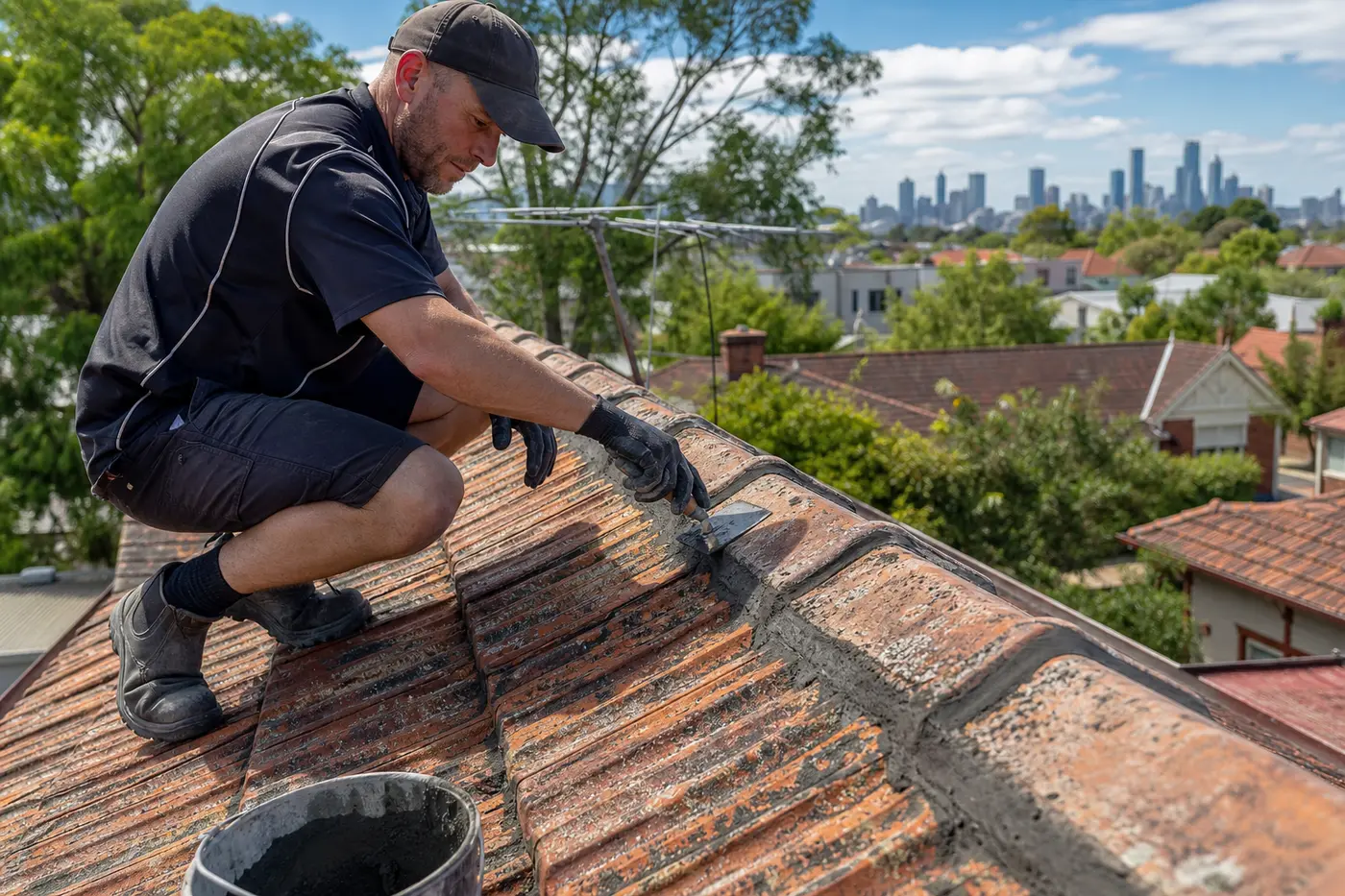
You go out to move the bins and there are little crumbs of grey mortar scattered across the driveway. A few days later, more. That grit is coming off the ridge of your roof, and it's one of the most common early warnings we see on homes right across the northern suburbs. It usually means your roof is due for repointing. If you have never had it explained, this is the plain version: what roof repointing is, how to tell your own roof needs it, and what actually happens when we do it.
Repointing is the mortar work along the ridges, not the whole roof
Look up at a tiled roof and you'll see the capping tiles that run along the top ridges and down the hips (the sloped edges where two roof faces meet). Those caps are held in place by a bed of mortar underneath, and then a second, finer layer of mortar seals the joint on the outside. That outer sealing layer is the pointing.
Over the years the pointing is what takes the beating. Sun, frost, rain and the roof gently expanding and contracting with the heat all work at it until it cracks, shrinks back and falls away. Repointing means raking out that failed material and laying a fresh seal along every cap. It's a targeted job on the ridges and hips, not a resurfacing of the entire roof.
Repointing and rebedding are two different things
People often use the words as if they mean the same job, so it's worth clearing up. Rebedding is the bigger fix: the caps are lifted off, the old mortar bed is removed, and the caps are laid back down on a fresh bed. Repointing is the lighter job that seals over the top. If the caps themselves are still sitting firm and only the outer seal has perished, repointing on its own is usually enough. If the caps have gone loose or the bed underneath has broken down, they need rebedding first, then pointing over that. A proper look at the roof is the only way to know which one you're actually up for.
Why the mortar gives way faster on northern-suburbs roofs
A lot of the housing here works against the old pointing. The interwar bungalows through Preston, Coburg and Reservoir carry terracotta tile roofs that are now 80 to 100 years old, and the original cement pointing on many of them has simply reached the end of its life. Up through the concrete-tile belt around Bundoora, Watsonia and Greensborough, the streets sit a bit higher and colder, and repeated frosts crack rigid old mortar over a winter or two.
The old-style cement pointing was the other problem. It sets hard with no give, so every time the roof heats up and cools down the mortar and the tile pull against each other. Hard mortar loses that fight. It fractures, lets go in flakes, and that's the grit you find on the ground. This slow crumbling is what roofers call fretting, and once it starts it doesn't stop on its own.
The signs worth acting on before winter
Most people can spot the early warnings from the ground with a decent look on a clear day. The ones we're asked about most often:
- Sandy or gritty mortar collecting in the gutters, on paths or down the driveway.
- Visible gaps, cracks or missing sections of pointing along the ridge line.
- Ridge caps that look like they've shifted, tilted or lifted at one end.
- Moss or lichen taking hold along the ridges, which keeps the joint damp and speeds the decay.
- A leak or a fresh water stain on the ceiling near a ridge or a hip after heavy rain.
Loose pointing is often part of a broader pattern of wear, so it's worth knowing the other warning signs a tile roof is asking for attention while you're looking. A ceiling stain near the ridge is the one to treat as urgent. By the time water is showing inside, it has usually been getting in for a while.
Why we point with flexible compound now
When we repoint, we don't go back to the rigid cement mix that failed. We use a flexible pointing compound instead. It bonds to the tile and the bedding, and then it moves a little as the roof expands and contracts through the day, rather than cracking apart at the first hot spell. That flexibility is the whole point. It's the difference between a seal that lasts and one that starts fretting again in a handful of years. On our repointing and rebedding work we back the job with a 10-year written guarantee on workmanship and materials, which tells you how much store we set by getting that seal right.
Where repointing fits with everything else
Sometimes the pointing is the only thing wrong and it's a standalone job. If the caps have loosened, if there's cracked mortar around the chimney, or if a few tiles have slipped, repointing gets bundled in with the other tile and ridge capping repairs your roof needs and it's all sorted in one visit.
Just as often, repointing is one step inside a full restoration. When a roof is being cleaned, re-bedded, primed and recoated anyway, fresh pointing along every ridge is part of that package rather than a separate call-out. If your tiles are also faded, porous or growing moss across the south-facing pitches, it's usually more sensible to do the lot together than to keep paying for one patch after another. That decision comes down to the condition of the whole roof and, honestly, your budget, so it helps to understand what a restoration tends to cost before you choose between the two.
It isn't a weekend DIY job, and here's why
This is a fair question and we get it a lot. Repointing means working along the peak of the roof, at height, on tiles that can crack under a misplaced foot and are slippery when there's any dew or moss about. Beyond the safety side, mixing and applying flexible pointing so it bonds properly and finishes cleanly takes practice. Get the mix or the application wrong and it frets again within a couple of years, so you end up paying to have it redone. For a working-at-height job like this we'd always suggest getting a licensed roofer up there rather than tackling it yourself. A proper inspection also tells you whether you genuinely need rebedding underneath, which is impossible to judge from the ground.
Get eyes on it before it turns into a leak
If you're seeing grit on the ground or gaps along the ridge, the sensible next step is a proper look at the caps before the winter rain finds the way in. We offer free inspections and quotes across Melbourne's northern suburbs, so you'll know exactly what your roof needs and what it involves. Call us on (03) 9498 1000, or book a roof inspection and repointing quote through our roof repairs team and we'll get up there and give you a straight answer.