
The electrician comes down from the manhole, dusts off their knees and mentions, almost in passing, that you've got no sarking. You've never heard the word before. Now you're wondering whether your roof is missing something important, and whether it's about to cost you.
It's a question we get a lot across Melbourne's north, usually from owners of interwar bungalows and postwar brick homes. Roof sarking is the protective layer that sits under the tiles or metal sheets, and plenty of older homes were simply built without it. That isn't automatically a problem. This guide explains what sarking does, how to tell if you have it, and when adding it is genuinely worth doing.
If you can see the back of your tiles, you probably don't have it
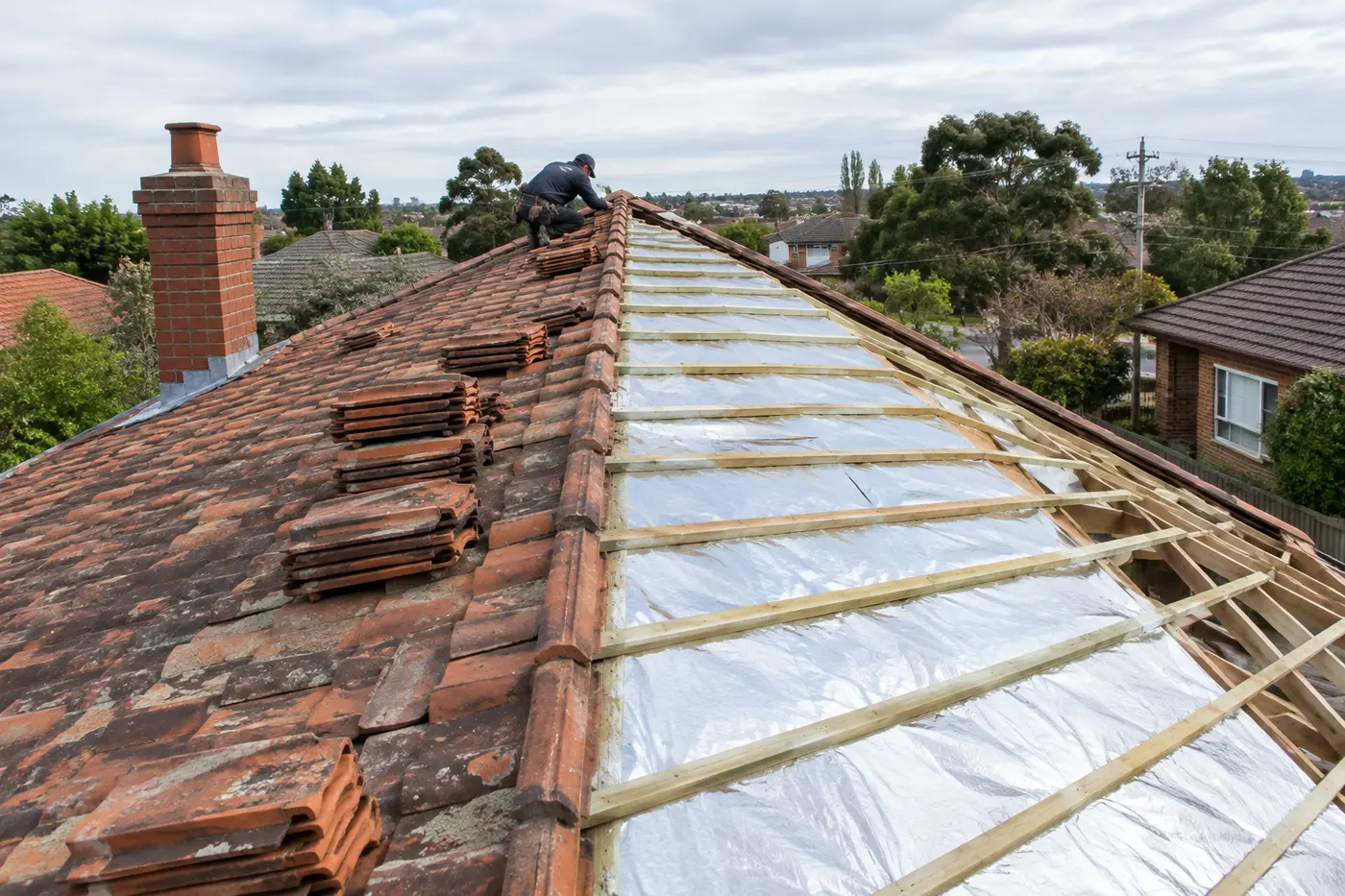
Sarking is a flexible membrane, usually a foil or woven fabric, laid across the rafters before the battens and tiles go on. From inside the roof space it looks like a continuous silver or grey sheet stretched over the timber.
So the easiest check is a look from the manhole with a torch. Stay on the ladder or a solid platform; ceiling plaster won't hold your weight between the joists. If you see a sheet running under the tiles, you have sarking. If you see the underside of terracotta or concrete tiles, the battens they hang on, and maybe a few chinks of daylight between them, you don't.
On a lot of the 1920s to 1950s homes through Preston, Coburg and Reservoir, it's the second picture. Newer estate homes further out, and nearly every metal roof we put on, have it.
Sarking is the backup, not the main waterproofing
This is the bit that surprises people. On a tile roof, the tiles do the real work. They overlap and interlock so rain runs down the surface and into the gutter. Sarking sits underneath as a second line of defence.
What it catches is the water and dirt that gets past the tiles anyway:
- rain blown up under the tiles in a strong southerly
- water coming through a cracked or slipped tile
- fine dust and grit, which is why roof spaces without sarking are often coated in black dust
That water runs down the sarking and drains into the gutter, rather than dripping onto the timber and your ceiling. Reflective foil types also bounce back some of the sun's heat before it reaches the roof space, which helps in a Melbourne summer.
What sarking won't do is fix a roof that's failing. If the ridge mortar has crumbled or a valley has rusted through, a lot more water gets in than sarking was ever meant to handle, and it will find its way off the edge of the sheet or through a tear.
A roof without sarking can still be perfectly sound
Some of the terracotta roofs we look at in Preston and Coburg are 80 to 100 years old, have never had sarking, and have gone most of that time without a leak worth talking about. The tiles were laid well, and someone kept an eye on the ridges and valleys.
The catch is that there's no margin for error. On a sarked roof, one cracked tile might drip harmlessly onto the membrane for months. On a roof without it, that same crack lets water straight onto the battens and the top of the ceiling every time it rains. That's why we're so keen on owners of older homes dealing with cracked or slipped tiles early rather than waiting for a stain to show.
In other words, a roof without sarking isn't a defect. It just needs its tiles, pointing and flashings kept in good order, because nothing is underneath to catch a mistake.
Adding sarking to an existing tile roof means the tiles come off
People often ask whether sarking can be slipped in under the tiles. On a tile roof, not properly. The membrane has to run over the rafters and under the battens, lapped so it sheds water down towards the gutter. To get it there, the tiles come off, the battens come off, the sarking goes on, then new battens and the tiles go back.
That's most of the labour of re-laying a roof. By the time you've done it, you're paying for a big chunk of a replacement while keeping your old tiles.
You'll sometimes see foil stapled between the rafters from inside the roof space and sold as sarking. It can help a little with heat, but it can't catch water and carry it to the gutter the way a properly laid membrane does, so don't count on it to protect your ceiling.
A roof restoration doesn't add sarking either. Restoration cleans, repoints and coats your tiles where they sit, which is why it costs so much less than a new roof. If you're weighing up which way to go, our guide to choosing between restoring and replacing walks through how we make that call.
The time to add sarking is when the roof is open anyway
We almost never recommend stripping a sound roof just to add sarking. It's hard to justify the cost when the tiles are doing their job.
It makes much more sense when the roof is coming off for another reason. If the tiles are porous, the battens have failed, or you're converting from tiles to Colorbond, the frame is bare anyway and sarking goes on at very little extra effort. On our full roof replacements, new breathable sarking is installed where the new roof type needs it, along with new battens. On older homes that never had it, that's a genuine upgrade rather than a straight swap, and it's covered by the same 10-year written warranty as the rest of the job.
When you're comparing replacement quotes, check that each one actually lists sarking, and whether it covers the whole roof. It's easy to leave out, and you won't see the difference from the street.
Metal roofs need it more than tile roofs do
Under a metal roof, sarking has a slightly different job. On cold Melbourne nights the steel sheets chill quickly, and warm moist air from the house can condense on their underside. Without a membrane, those droplets fall onto the timber and the insulation. Sarking catches them and keeps that moisture out of the roof space.
It also helps with the noise people worry about. A Colorbond roof with proper sarking and insulation underneath is no louder than tile in heavy rain. The old corrugated iron roofs that rattle in a downpour are usually the ones without either. On the metal roofs we install, breathable reflective sarking goes in as standard.
Old sarking can tear, sag or go brittle
Having sarking doesn't mean it's still doing its job. On roofs that do have it, we often find it torn where antenna installers, solar crews or other trades have worked through the tiles. Some older products also sag between the rafters over time, forming a little pocket where water pools instead of running off.
If you're up at the manhole and see rips, sagging sections or water marks on the sheet, it's worth having a roofer look at what's happening above it. Usually the sarking is telling you about a tile or flashing problem higher up, and that's what needs fixing.
In bushfire areas, ask before you re-roof
Around Eltham and the treed blocks on the city's north-east edge, sarking has another role: it helps stop burning embers that get under the tiles from reaching the timber. If your property is in a bushfire-prone area, the building rules for a new roof can affect what has to go underneath it. Raise it with your roofer before you sign a replacement quote, so it's built into the job from the start.
Not sure what's under your tiles?
If you've just found out your home has no sarking, the honest answer is usually that nothing needs to happen today. The thing to keep on top of is the condition of the tiles, ridges and valleys above. If your roof is due for replacement, or you're thinking of switching to metal, that's the moment to get sarking in. Our free inspections and quotes will tell you which situation you're in, and you can see everything a new roof from us includes before you decide.