
The call usually goes something like this. It poured overnight, and this morning there's a damp line across the hallway ceiling, not a round stain but a long streak, as if someone ran a wet brush along the plaster. The homeowner has had a look from the footpath and the tiles seem fine. More often than not, when the stain runs in a line like that, we go up and find the problem sitting in a valley. Roof valley repair is one of the jobs we do most often on older homes across Melbourne's north, and it's also one of the most misunderstood.
This post explains what a valley is, how they fail, how to spot the signs from inside the house, and what actually happens when one gets repaired or replaced. No ladders required on your part.
A valley carries more water than any other part of your roof
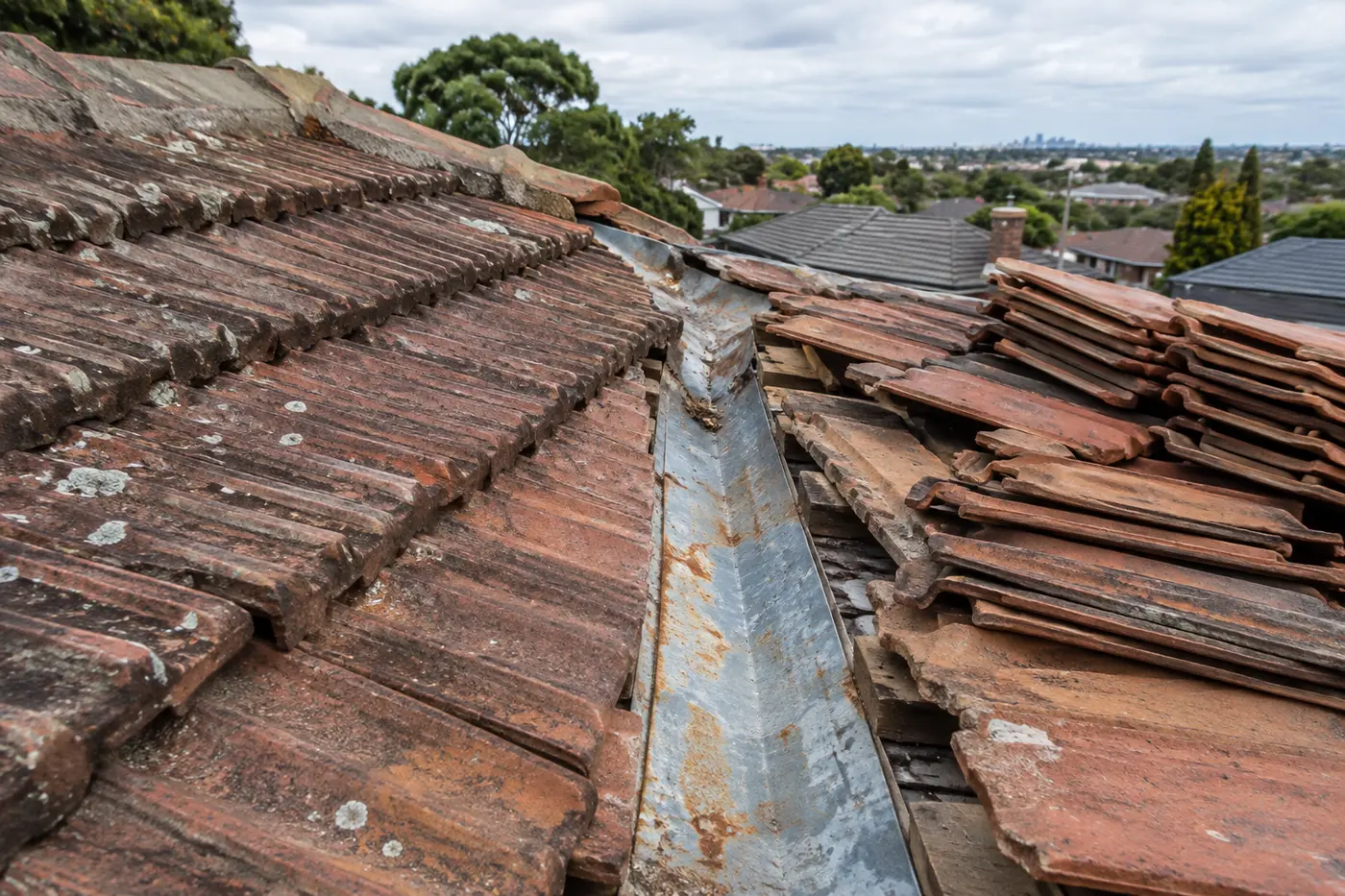
A valley is the V-shaped channel where two roof slopes meet at an inside corner. Picture an L-shaped house: where the two wings join, the roof folds inward and forms a trough. In that trough sits a strip of metal, usually called a valley iron or valley flashing, and the tiles on either side are cut to sit over its edges.
Every drop of rain that lands on both of those slopes ends up running down that one channel. In a heavy Melbourne downpour, that's a lot of water moving fast through a narrow gap. A cracked tile out in the middle of the roof lets in a trickle. A failed valley can let in a steady stream, right along its full length.
How valleys fail on homes in the north
The way a valley fails depends mostly on what it's made of and what's growing over it.
The metal wears out. Old galvanised valleys on interwar and postwar homes in Preston, Coburg and Reservoir rust from the inside of the V outwards, often where wet leaves have sat against the metal for years. Old lead valleys tend to crack across the bottom of the V after decades of heating and cooling. Aluminium valleys can corrode or lift at the edges.
Leaves dam the channel. This is the big one in Ivanhoe, Heidelberg and Eltham, where mature trees hang over the roof. Leaf litter, bark and seed pods pile up in the valley, hold moisture against the metal and eventually block it. When a blocked valley meets heavy rain, water backs up and spills sideways under the tiles on both sides.
The tiles beside it shift. The cut tiles along each side of a valley are often held with mortar. When that mortar cracks and the tiles slip or sit too far into the channel, they catch debris and push water where it shouldn't go.
Some older homes never had a proper valley at all. Some older roofs have what's called a wet valley, where the tiles meet in the corner without a separate metal channel underneath. These collect debris and eventually overflow, and the lasting fix is converting them to a properly flashed valley.
The signs usually show up inside first
You can tell a fair bit without going near the roof. A ceiling stain that runs in a line, rather than sitting as a single round patch, is the classic valley sign, because the water is following the valley line above. Leaks that only appear in heavy rain and dry up in light showers point the same way: the valley copes until the volume gets too much for it.
From the ground, you might spot rust streaks running down the tiles below a valley, or a visible clump of leaves sitting in the corner after autumn. If the stain is closer to a chimney, a wall or a skylight, the flashing at that join is a more likely suspect, and our post on how flashings fail around chimneys and walls covers those.
Keep in mind that water travels. It can enter at the valley, run along a rafter and drip through the ceiling well away from where it came in. A stain points you in the right direction. It doesn't prove anything on its own.
Repair or replace: what decides it
Not every leaking valley needs ripping out. If the metal is still sound and the problem is a blockage, or a few slipped tiles along the edge, a clean out and properly rebedding and pointing those tiles can fix it. That's a smaller job, and it's the right one when the valley itself has years left in it.
Once the metal has rusted through, cracked or been patched over before, the honest answer is replacement. You can't reliably seal a hole in the bottom of a channel that carries that much water. We see plenty of valleys smeared with silicone or roofing tape from an earlier fix. The mastic sealants used on roofs dry out and crack within 15 to 20 years, and on a valley, a patch usually lasts a lot less than that before it's leaking again, often with wet timber underneath by then.
The other thing that tips it towards replacement is age across the whole roof. If one valley has rusted through, the others were usually installed at the same time from the same material. It's worth checking them all while someone is up there.
What a valley replacement looks like on the day
The work itself follows a set order. The tiles down both sides of the valley come off and get stacked safely on the roof. The old valley iron is pulled out, and we check the timber and battens underneath, because a valley that has leaked for a while can leave soft or rotted wood behind. The new valley is fitted, the tiles go back on, and the cut tiles along each edge are bedded and pointed so they sit correctly over the channel.
For the new valley we use aluminium or lead. Aluminium is lighter and quicker to install on a standard home. Lead is the traditional choice and the one we use on heritage roofs in places like Brunswick and Northcote, where the look matters. In Victoria, valley replacement is licensed roof plumbing work, which is worth checking before anyone starts. It's a core part of our roof plumbing and valley replacement service, and we'll tell you at the inspection which material suits your roof.
Valley guard only helps a valley that's still sound
Valley guard is a coarse mesh laid over the valley that stops leaves and bark settling in the channel while still letting water run through. On treed blocks it makes a real difference. In Eltham, where the CFA has assessed parts of the suburb as Very High Bushfire Risk, keeping dry debris out of valleys is a fire safety issue as well as a leak issue.
The catch is that guard is for keeping a good valley good. Putting it over a valley that's already rusting just hides the problem under a layer of mesh. We check the valley first, and if it's on its way out, it gets replaced before any guard goes on.
What moves the price
We don't publish prices, because valleys vary too much for a single number to mean anything. The things that move a quote are practical: how many valleys need work and how long they are, whether it's a repair or a full replacement, the material, how high the roof is and how easy it is to reach, whether replacement tiles can be matched, and whether there's water damage underneath to deal with. A short valley on a single-storey bungalow is a very different job from a long valley on a steep two-storey roof.
If the leak has already marked the ceiling, the plaster repair is usually a separate job on top. Our guide to what fixing a leaking roof costs goes through how those costs stack up and why getting onto a leak early keeps the total down.
Got a stain running along the ceiling, or rust showing where two roof slopes meet? We inspect and fix valleys across Melbourne's northern suburbs, and the inspection and quote are free. Book in with our roof plumbing team and we'll photograph the valley, tell you plainly whether it needs repair or replacement, and give you a fixed price before any work starts. Call (03) 9498 1000.