
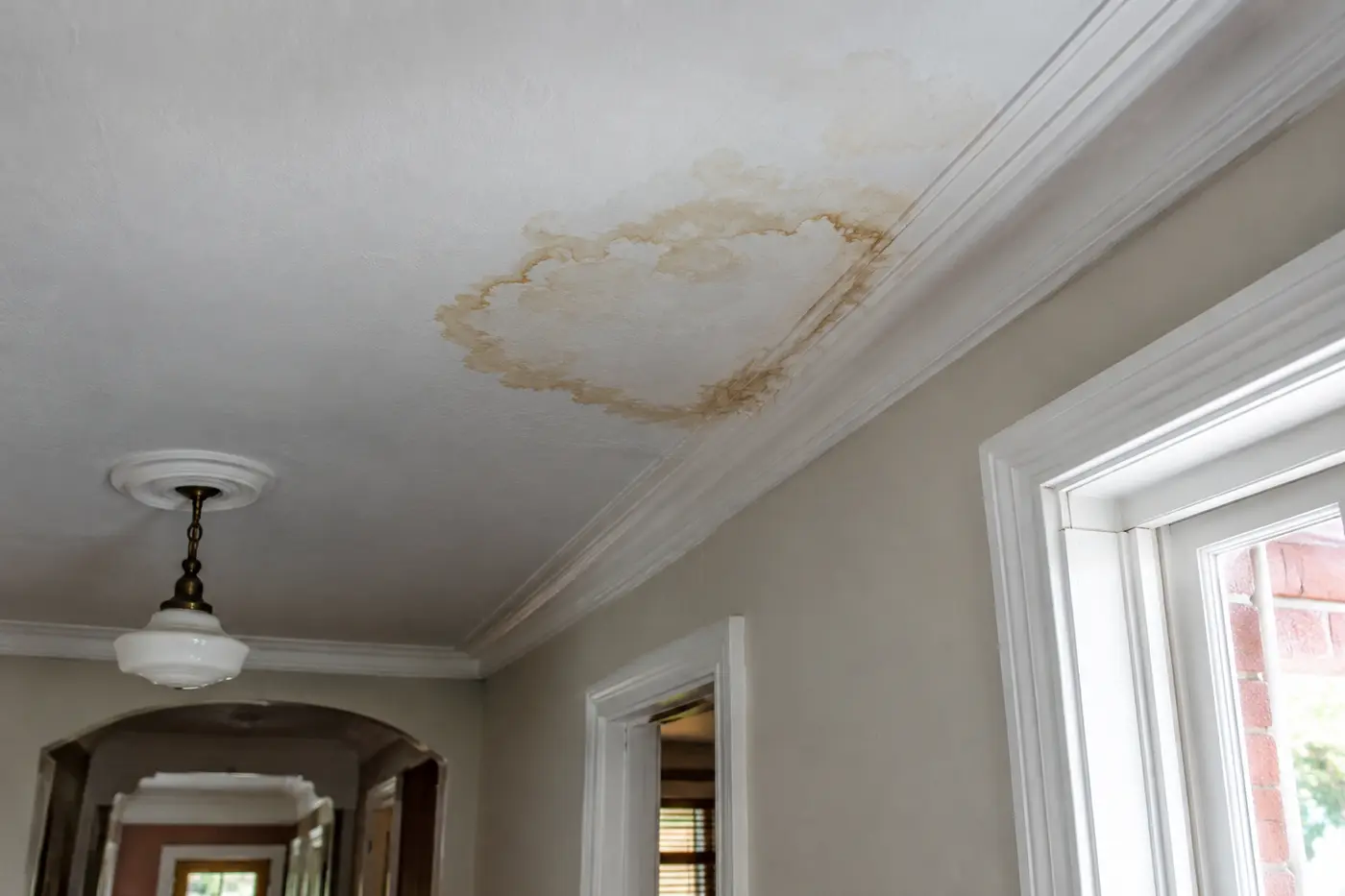
It usually gets noticed by accident. You're lying on the couch or walking down the hallway, and there's a yellow-brown ring on the ceiling that you're fairly sure wasn't there last month. It isn't dripping. It isn't even damp to the touch. A water stain on the ceiling like that is easy to ignore, and most people do for a while. But it means water got somewhere it shouldn't, and the stain holds more clues about where that water came from than most people expect.
Here's how we read a ceiling stain when we're called out to one in Melbourne's north, what else it can mean besides the roof, and the few signs that mean you shouldn't wait.
The ring is old water. What matters is whether new water is coming.
Those brown edges form as water soaks into the plaster and then dries out. Dust from the roof space and colour from old timber get carried along with the water and left behind at the edge, like a tide mark. So a stain tells you water was there. It doesn't tell you it's still coming.
The easiest test costs nothing. Take a photo of the stain now, with something in the frame for scale, and take another after the next decent rain. If the stain has grown, darkened or picked up a second ring, the leak is active. If nothing changes over a few wet weeks, it may be an old leak that was already fixed, which is common in houses that have changed hands. Even then, it's worth having the roof checked so you know for sure. Those dated photos are also handy if you end up talking to your insurer.
Where the stain sits tells you most of the story
Water rarely drips straight down from where it gets in. It runs along battens, rafters and sarking (the foil or membrane under the tiles) before it falls, so the stain is a starting point rather than an exact address. Even so, its position narrows things down quickly.
- Along an outside wall or in a corner. Often the gutter. When gutters fill with leaves, water backs up over the inside edge and runs into the wall or the edge of the ceiling. We see this constantly under the big street trees of Ivanhoe, Heidelberg and Northcote.
- In the middle of a room. Stand outside and picture where the stain sits under the roof. Below a ridge line points to loose ridge caps or worn pointing. Below the dip where two roof slopes meet, suspect the valley.
- Around a chimney breast, flue, skylight or vent pipe. Flashing problem, most likely.
- Near an evaporative cooler outlet. More on this below.
- Directly under an upstairs bathroom. Probably a plumber, not a roofer.
Anything that pokes through a roof needs flashing, a strip of metal or flexible material that seals the gap around it. Old flashing lifts, cracks or loses its seal, and it's one of the most common causes of a stain that seems to have no obvious source.
Not every ceiling stain is a roof leak
We'd rather say that up front than send someone onto your roof for nothing. Three other culprits turn up regularly.
Evaporative coolers. Plenty of homes in the northern suburbs have one sitting on the roof. They can leak from the unit itself, from a blocked drain line, or around the seal where the duct passes through the roof. The giveaway is timing: a stain that grows on hot days when the cooler has been running, rather than after rain. The cooler unit is a job for a cooler technician. The flashing where it meets the roof is ours.
Plumbing. In a two-storey house, a stain under the bathroom or ensuite is far more likely to be a shower, bath seal or pipe than the roof. Single-storey homes can have water pipes running through the roof space too. If the stain grows whether it has rained or not, think plumbing first.
Condensation. On cold, still winter mornings, warm moist air from showers and cooking can condense on the underside of the roof and drip back onto the ceiling. It tends to show up over bathrooms and laundries, often with a musty smell. Our guide to tracing winter roof leaks to their source explains how to tell the two apart.
As a rough rule, if the stain only grows after rain, it's most likely the roof or gutters. If it appears regardless of the weather, look elsewhere first.
Three signs it shouldn't wait for a convenient week
Most ceiling stains are slow problems. A few aren't.
A sagging or bulging ceiling is the big one. Plasterboard that has soaked up water gets heavy and soft, and it can come down. Keep people and pets out from underneath, move what you can, and don't poke it.
Water near a light fitting or downlight is the second. Turn that circuit off at the switchboard and leave it off until an electrician has checked it.
The third is a stain that's wet to the touch, spreading, or growing mould. That means water is getting in every time it rains, and the plaster, insulation and timber above are staying wet. If water is actually dripping into the room, our guide to handling an active roof leak covers the steps to take straight away.
Painting over the stain only hides it for a while
It's tempting to grab a tin of ceiling white. Hold off. Water stains bleed through ordinary paint, so the mark comes back. Worse, if the leak is still going, you've covered up the only early warning you had while the timber and insulation above keep getting wet.
The order that works is simple. Find and fix the source, let the ceiling dry out completely, then deal with the stain. A lightly marked ceiling can usually be sealed with a stain-blocking primer and repainted. Plasterboard that has sagged, crumbled or gone mouldy generally needs that section cut out and replaced. Either way, the ceiling is the last step, not the first.
What we check when we come out to a stain
We start inside. A look at the stain, then up through the manhole with a torch to see the underside of the roof above it. Wet timber, stained sarking or damp insulation leaves a trail, and it usually leads uphill toward where the water is getting in.
Then we go up on the roof with proper safety gear and check the likely suspects for that part of the house. On the interwar bungalows of Preston and Coburg, where the terracotta roofs are now 80 to 100 years old, it's often fretting ridge mortar or a cracked or slipped tile. Across the 1960s and 70s concrete tile homes of Bundoora, Watsonia and Greensborough, ridge capping is a regular cause. On the newer Colorbond roofs in Craigieburn, we look hard at the flashings and roof screws. And anywhere with big trees nearby, we check whether a valley has filled with leaves and started backing water up under the tiles.
Most stains trace back to one fault that can be fixed with a targeted roof leak repair, without touching the rest of the roof. If the inspection turns up a roof that's tired all over, we'll tell you that too, and you can decide what to do from there.
Get the stain looked at before the next wet spell
If there's a ring on your ceiling and you're not sure where it came from, we're happy to take a look. Inspections and quotes are free, and we'll tell you plainly whether it's the roof, the gutters or a job for a different trade. Book a visit through our roof repairs page or call us on (03) 9498 1000.